Update: Per a tweet from @TheologeticsOrg, they have removed the reference to the Ebla Tablets from their Theologetic Table (though it still appears on the PDF). This is encouraging to see, though improvements to their research – especially to the quality of their sources – would be nice as well. But progress is progress!

Recently, I was engaged in a (brief) back-and-forth with the Twitter1 account @TheologeticsOrg. For those unfamiliar with the account, @TheologeticsOrg is connected to the website theologetics.org, an apologetics site that uses some creative tactics to communicate their message. In addition to various games for purchase, the site features a “Theologetic Table of Evidence,” an idea inspired by the Periodic Table of Elements. It is truly a well-organized and clever evangelistic and apologetic tool. The thought and energy put into it the framework is impressive, even if the content is often lackluster at best. Some parts of the Table, available in a PDF from the site, are worse than lackluster – they are outdated. In this post, I want to look at one example from p. 8 of that PDF.
Spelunking in a Quote Mine
Page 8 of the Table is all about the relationship of archaeology to the Bible. Unfortunately, the beginning of the section immediately raises two red flags.
To preface the discussion on archaeology and the Bible, the page begins with two quotes. The first is attributed to the late William Albright, perhaps one of the most recognizable names from the field of archaeology: “There can be no doubt that archaeology has confirmed the substantial history of Old Testament tradition.” The second is from another important voice from the history of archaeology, the late Nelson Glueck: “It may be stated categorically that no archaeological discovery has ever controverted a biblical reference.” It is obvious why Theologetics chose these two particular quotes. Both Albright and Glueck, colleagues who worked together until World War Two,2 belonged to or were at least forerunners of the biblical maximalists. Maximalists, Eric Cline explains, “argue that the biblical stories are indeed both completely factual and historically accurate, even if they cannot always be verified by archaeology.”3 The quotes, then, from Albright and Glueck are performative, signaling to the reader that Theologetics falls into the maximalist camp.
While I disagree with the maximalist camp, the fact that Theologetics appears to be part of it is not a red flag. In all honesty, given everything else I know about them – their views on evolution and position on inerrancy – maximalism is virtually entailed. Instead, the first red flag that comes up for me has to do with how Theologetics handles sources and attribution. Following the two quotes, readers will find an endnote – “(1)” – which points to an article entitled “The historical and archaeological evidence for Biblical accuracy and One Way to God” written by Andy and Berit Kjos.4 I am not a scholar and do not know who Andy and Berit Kjos are, but I do know that they are not William Albright or Nelson Glueck. It appears, then, that rather than track down their sources and cite them directly, Theologetics has gotten them second hand.
Except that isn’t exactly true. When you look at the piece by the Kjos’s, you find that they aren’t directly citing Albright and Glueck either. Though they include in their citation the sort of information required by good citation practice, it is nevertheless clear that they did not get either the quotes or the citation data from a reading of the works themselves but from another source, an article by Rabbi Glenn Harris from the website gospeloutreach.net.5 And so, Theologetics has not gotten the quotes from Albright and Glueck first hand or second hand but third hand!
Except that isn’t exactly true either. If you look at the piece by Harris, he – like the Kjos’s – offers citation data but openly states that he retrieved the quotes not from reading the works by Albright or Glueck but from Josh McDowell’s Evidence That Demands a Verdict! And so, Theologetics has not gotten the quotes first hand or second hand or third hand but fourth hand.
That is quite the quote mine! While it isn’t the first time apologists have made use of such a tactic,6 it raises some important questions about the quality of their work. For one, it suggests to me that their research skills never progressed out of what you might find from the average American high schooler armed with a high-speed Internet connection and a deadline of yesterday. For another, it makes me wonder why they couldn’t be bothered to track down sources and cite them directly. Is this indicative of laziness? Do they not think that quality matters? Do they think that the issue is unimportant? Additionally, citations are important because they say to the reader, “Please, fact-check me.” It is at once a sign of confidence and humility, a way of communicating, “Yes, I’ve done the work. But please, don’t take my word for it.” In this light, a well-crafted footnote or endnote is a thing of beauty. That Theologetics prefaces their brief examination of archaeology and the Bible with such poor methodology calls into question what they’ve produced.
Voices from Yesterday
The second red flag are the voices behind the quotes themselves. Both Albright and Glueck were well-respected scholars, making significant contributions to the field of archaeology. Nevertheless, they represent in many ways outdated scholarship. Both men died in 1971, over half a century ago. Anyone who has even a cursory interest in archaeology of the Levant knows that much has changed since their deaths. To cite them as authorities on the current state of research as Theologetics seems to be doing is foolhardy. In a particularly poignant statement made two decades after Albright’s death, archaeologist William Dever wrote,
Finally, we must ask what is of lasting value in Albright’s Biblical and historical syntheses. The answer is, very little. His central theses have all been overturned, partly by further advances in Biblical criticism, but mostly by the continuing archaeological research of younger Americans and Israelis to whom he himself gave encouragement and momentum. The negative side of all this is that the “revolution” that Albright confidently predicted has indeed come about at last, but hardly in the way that he anticipated – quite the opposite. The irony is that, in the long run, it will have been the newer, “secular” archaeology that contributed the most to Biblical studies, not “Biblical archaeology.”7
The landscape has hardly shifted. As Assyriologist Joshua Bowen observes, “By the mid-1980s, ‘biblical archaeology’ had given way to a new, secular form of Near Eastern archaeology…. While there are many factors that have been involved in this transition from a biblical to a secular one, one of the significant catalysts has been the various historical problems with the biblical account that have been brought to light by the archaeological data.”8
What is of concern here with Theologetics is that they are passing as voices relevant to the modern study of archaeology and the Bible those from a bygone era. This suggests to me that they haven’t kept up with the secondary literature, choosing instead to cling to outdated research that suits their views rather than finding more contemporary voices to support them. While maximalism is not anywhere near the consensus view among archaeologists, there are nevertheless many scholars who lean that direction from whom Theologetics could have quoted. That they do not speaks either to their ignorance or their apathy, neither of which strike confidence in their work.
The Ebla Tablets
The aforementioned red flags appear throughout the Theologetic Table generally and in this section on archaeology in particular. It is to one example we now briefly turn: the Ebla Tablets.
Before we begin, let me briefly explain what the Ebla Tablets are.9 At the modern city of Tell Mardikh in northern Syria, archaeologists discovered the remains of the ancient city of Ebla. Prior to the find, the city was known from ancient texts but was otherwise unconfirmed until the 1960s.10 Among the ruins, thousands of cuneiform texts were found, many dating to the third millennium BCE. While roughly eighty percent are administrative texts,11 a variety of types of texts are attested including word lists, literary texts, letters, and more.12
Early on, a few researchers thought they found among the cuneiform texts references to people and places mentioned in the Hebrew Bible. The Assyriologist Giovanni Pettinato, for example, was famous for claiming that the cities of the plain mentioned in Genesis 14:2 could be found among the Ebla Tablets, asserting that references to si-da-muki were references to biblical Sodom.13 But how did this purported connection between the Ebla Tablets and the Bible hold up?
Before we answer that question, let’s return to the Theologetics Table of Evidence In the section of p. 8 on “a few of the more important archaeological discoveries,” Theologetics lists as one the Ebla Tablets. Here is what they say:
The word “Canaan” appears, contrary to the claims of the critics. The tablets proved that the term was actually used in ancient Syria during the time in which the Old Testament was written. Additionally, the cities of Sodom and Gomorrah were also thought to be pure fiction by Bible critics. These cities are also identified in the Ebla tablets, in addition to the city of Haran. Haran is described in Genesis as the city of Abram’s father, Terah. Previous to this discovery, ‘scholars’ suspected the actual presence of the ancient city.
To substantiate this paragraph, they include an endnote, “(6).” At the end of the page, note 6 points to an article, presumably titled (based on the full URL) “Critics of Bible Silenced Again: Archaeological Discoveries Prove Old Testament to Be Accurate,” on the website christiansinpakistan.com. However, clicking the link leads to nowhere, as this screenshot shows.
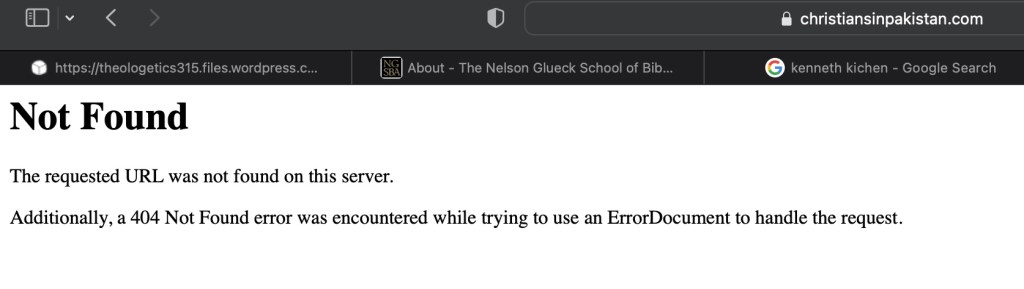
Typing in christiansinpakistan.com leads to a totally unrelated site, suggesting that the website is for all intents and purposes defunct and was purchased by a different entity altogether. So, one cannot even interrogate Theologetic’s source, at least not directly.
To see if this information could be found elsewhere, I copied and then pasted into Google the entire paragraph on the Ebla Tablets. This led me to an article entitled “Bible Critics Silenced Once Again as Archaeological Discoveries Prove Old Testament To Be Accurate.”14 I am reasonably certain this is at least mirroring the original article given that at the end of the piece we find the reference “Ex: christiansinpakistan.” Additionally, there is verbatim agreement between that site and the material presented by Theologetics, suggesting that it is some iteration of the source that Theologetics used. If it is, then there is little to commend it.
Nothing in the piece is substantiated. There are no quotes from archaeologists, no citations of any kind, and no analysis of any relevant data. It makes little more than bald assertions, giving the veneer of support for biblical accuracy without actually providing it. This is alarming and again raises questions about how Theologetics conducts (or doesn’t) its research. Could they not be bothered to track down and provide scholarly literature on the tablets? Or do they simply not care whether the sources that they provide are of good quality?
More important is the question I asked earlier about the connection between the tablets and the Bible. Were researchers who proposed a link correct? Could the cities of Sodom and Gomorrah, for example, be found in the tablets? The answer, as it turns out, was no. Eric Cline summarizes:
In the 1970s, a flurry of excitement took place when it was announced that texts found at the site of Ebla in Syria dating to the third millennium B.C. mentioned the five Cities of the Plain, including Sodom and Gomorrah, listed in the same order as in the Hebrew Bible. These readings, however, were soon shown to be faulty. The tablets were written in a previously unknown language, referred to by researchers as Eblaite or Eblaitic, which took some time to properly decipher and translate. In the end, the city that had first been identified as “Gomorrah” (é-ma-raKI)in the Ebla tablets turned out to be a probable reference to ancient Emar, a major town on the Euphrates River. As for the city first identified as “Sodom” (si-da-muKI), its real identity has not been ascertained, but it is thought to be somewhere in northwest Syria – nowhere near the Dead Sea, and completely unrelated to the account found in the Bible.15
So, with more research and work, older views about the presence of the otherwise unattested cities of Sodom and Gomorrah in the Ebla Tablets were overturned. Indeed, the utility of the Ebla Tablets as they pertain to biblical studies is relegated to background. As John Bartlett explains, discoveries of texts like the Ebla Tablets “raised both public and scholarly interest in biblical history; but they illuminated the near-eastern background to the Bible rather than the Bible itself, and are now the concern primarily of specialists in these fields.”16
What Now?
With this information, it is difficult to conclude anything other than that Theologetics is relying on outdated research from an unreliable source. While I am unable to speak to the issues concerning Canaan or Haran, largely because it isn’t clear to me what “critics” said about them on account of the fact that Theologetics never references any specific critics or what they’ve said, at least with regards to Sodom and Gomorrah it is clear that the apologists are here wrong. The question becomes, What will they do with this information? Will they correct themselves or will they double down? Will they improve the quality of their sources and citations or will they exhibit the same carelessness that is characteristic of their work?
Because if this is the best these apologists have to offer, consider me unimpressed.
ENDNOTES
1 I absolutely refuse to call it “X.”
2 “Our founder: Nelson Glueck (1900-1971) (n.d.), ngsba.org. Glueck was also one of Albright’s students at the American Schools of Oriental Research.
3 Eric H. Cline, Biblical Archaeology: A Very Short Introduction (Oxford: Oxford University Press, 2009), 59.
4 Andy and Berit Kjos, “The historical and archaeological evidence for Biblical accuracy and One Way to God” (n.d.), crossroad.to.
5 Rabbi Glenn Harris, “Can I Trust the Bible?” (n.d.), gospeloutreach.net
6 See, for example, my post “Frank Turek and Tryggve Mettinger: Caught in a Quote Mine” (8.26.21), amateurexegete.com, or “With Christian Apologists It’s Never ‘Trust But Verify,’ It’s Only Ever ‘Verify’” (5.31.22), amateurexegete.com.
7 William G. Dever, “What Remains of the House That Albright Built,” The Biblical Archaeologist 56, no. 1 (March, 1993), 34. Emphasis original.
8 Joshua Bowen, The Atheist Handbook to the Old Testament (Mechanicsville, MD: Digital Hammurabi Press, 2021), 1:123, 124.
9 For an overview of the discovery and location of the tablets, see Alfonso Archi, Ebla and Its Archives: Texts, History, and Society (Boston: Walter de Gruyter, Inc., 2015), 77-92.
10 Paolo Matthiae, “Ebla,” in The Oxford Encyclopedia of Archaeology in the Near East, edited by Eric M. Meyers (Oxford: Oxford University Press, 1997), 2:181.
11 Maria Giovanna Biga, “Discovering History through the Ebla Tablets,” in Ancient Syrian Writings: Syrian Preclassical and Classical Texts (Damascus: General Secretariat of Damascus Arab Capital of Culture 2008, 2009), 29.
12 See Robert D. Biggs, “Ebla Texts,” in The Anchor Bible Dictionary, edited by David Noel Freedman (New York: Doubleday, 1992), 2:265-267.
13 See Giovanni Pettinato, “Ebla and the Bible,” The Biblical Archaeologist 43, no. 4 (Autumn, 1980), 213.
14 “Bible Critics Silenced Once Again as Archaeological Discoveries Prove Old Testament To Be Accurate” (n.d.), sundayadelajablog.com.
15 Eric H. Cline, From Eden to Exile: Unraveling Mysteries of the Bible (Washington, DC: National Geographic Society, 2007), 44-45.
16 John R. Bartlett, “What Has Archaeology To Do with the Bible – Or Vice Versa?” in Archaeology and Biblical Interpretation, edited by John R. Bartlett (London: Routledge, 1997), 6.
 The Amateur Exegete
(1) Well done, Ben. Once again, your ability to persevere under the burden of Brandolini’s Law borders on the superhuman. I tip my fez to you, sir.
(2) Beneath the underwhelming scholarship that you thoroughly address here lurks another problem, a common, fundamental category error from which so many historical apologetics suffer. Alignments of geographical and archaeological evidence with ancient narratives are of no reliable value in assessing the accuracy of the miracle claims we find in those narratives. Yes, there is good evidence for many of the places, peoples, materials, technologies etc. named in the books of the Bible. Same with the Epic of Gilgamesh. And the Iliad and the Odyssey. And Beowulf. And so on. (If it were within my power, I’d rename the Spider-Man Fallacy to the Gilgamesh Fallacy.)
I mean, of course these sorts of works frequently reflect the world in which they were composed, and the cultural knowledge of the authors who wrote them. It would be astonishing if the the narratives *didn’t* get at least some of that stuff right. But archaeological evidence of, say, West Semitic slaves in Middle Kingdom Egypt is no more confirmation of the Plagues and Red/Reed Sea crossing than the presence of lapis lazuli and fire-baked bricks in the ruins of ancient Uruk are confirmation that Gilgamesh and Enkidu tussled with the gods and Humbaba. The Histories of Herodotus and Geoffrey of Monmouth’s History of the Kings of Britain contain any number of verifiable and verified material and geographical details. But no-one, including Christian apologists, would argue those details move the epistemic needle with regard to Herodotus’ account of the Greek divinities intervening to preserve Delphi from marauding Persians, or Geoffrey’s attribution of Stonehenge to Arthur and Merlin.
LikeLiked by 1 person
You’re absolutely right. There’s this apologetic impulse to run to non-sequiturs. Apologists rarely (never?) show step-by-step how these little cultural details prove this or that specific claim from any given text. Theologetics does that frequently in their work. Frustrating!
LikeLike