INTRODUCTION
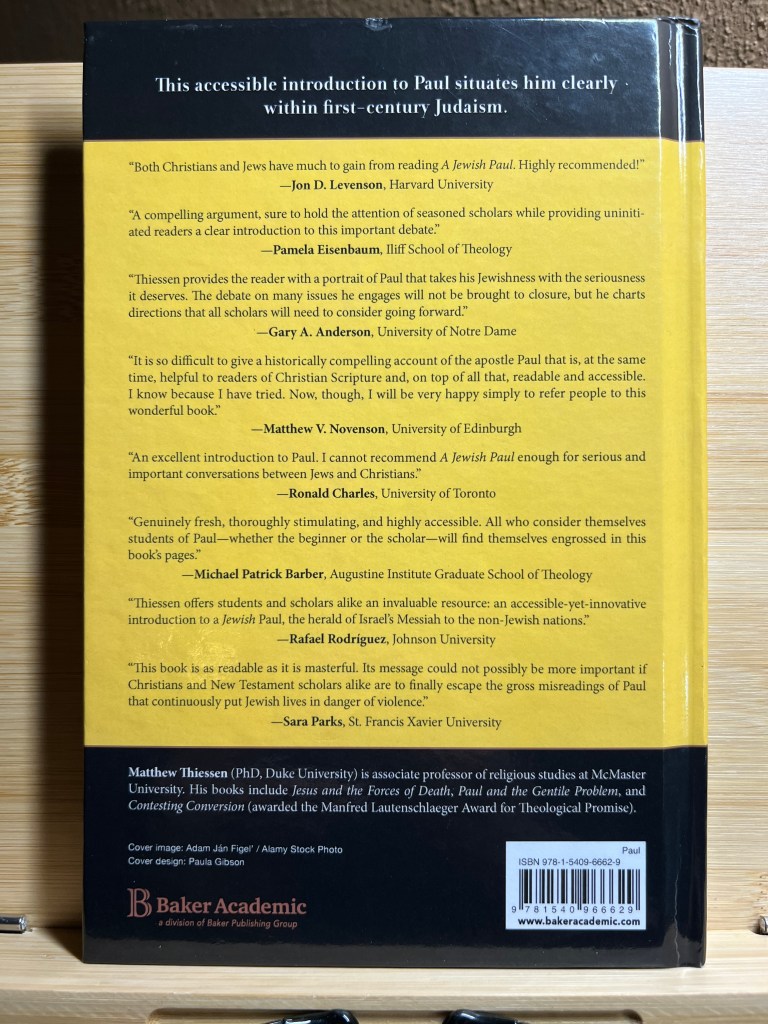
Were you to ask me what volumes I would recommend introducing someone to the life and thought of Paul the apostle, I would straightaway recommend three: J. Albert Harrill’s Paul the Apostle: His Life and Legacy in Their Roman Context,1 Pamela Eisenbaum’s Paul Was Not a Christian: The Original Message of a Misunderstood Apostle,2 and, my favorite, Paula Fredriksen’s Paul: The Pagans’ Apostle.3 But a recently published volume has me wondering if I need to turn this trio into a quartet – Matthew Thiessen’s A Jewish Paul: The Messiah’s Herald to the Gentiles.4 Thiessen, an associate professor of religious studies at McMaster University in Hamilton, Ontario, Canada, is the author of three other volumes: Contesting Conversion: Genealogy, Circumcision, and Identity in Ancient Judaism and Christianity (Oxford University Press, 2011); Paul and the Gentile Problem (Oxford University Press, 2016), and Jesus and the Forces of Death: The Gospels’ Portrayal of Ritual Impurity within First-Century Judaism (Baker Academic, 2020).5 With his latest volume, our author seeks to answer a single but salient question: “How does Paul relate to the Judaism (or, perhaps better, Judaisms) of his day?” (p. 3)

SUMMARY
With the volume’s introduction, Thiessen lays out the various ways that question has been answered. Though appreciative of certain elements found within a trio of popular interpretive frameworks, he nevertheless finds himself opposed to a view held common among them “that Paul must have thought something was inherently flawed with, wrong about, or absent from Judaism” (p. 9). Set in his own context, our author argues, Paul is best understood as “one ancient Jew living and thinking and acting within a diverse Jewish world” (p. 10). Getting to that context is easier said than done, but our author manages to (in the words of the title of ch. 1) make Paul weird again, first by problematizing jargon like “Christian,” “apostle,” and more, and then, by donning the mantle of a paleontologist, urging us to read Pauline fossils (i.e., his letters) in light of the stratum in which they were composed. So, when Paul makes known how he detests the idea of circumcision for gentile Christ-followers (e.g., Galatians 5:2-6), he is espousing a view about gentile conversion that already existed by the time he arrived on the scene.
Yet readers have taken texts like the aforementioned section from Paul’s letter to the Galatians and universalized them, contending that they apply equally to gentile and Jew. This, Thiessen tells us in ch. 2, is an error because not only is Paul by-and-large locked in on issues that concern non-Jews, one of the earliest readers of Paul, the author of the Acts of the Apostles, portrays him as one who would never call Jews to abandon Torah nor abandon it himself. Acts, positioned as it is prior to the Pauline corpus in the canon, becomes, per our author, an “authoritative interpretation of Paul, meant to keep people from misreading and misusing Paul’s letters” (p. 28). Part of the issue, as ch. 3 reveals, is that we often don’t get Paul’s context with its dichotomy of Jews and everyone else. Thus, some readers mistakenly read texts like Galatians 1:13-14 and suppose the apostle abandoned Judaism entirely. But this reading misses Paul’s point, our author demonstrates. Paul did not abandon Judaism but instead left one way of being a Jew for another. It is within this alternative way of being Jewish that Paul made it his mission to bring the good news to non-Jews, requiring not that they become Jews but urging them to remain gentiles.
This conviction about gentiles was rooted in his eschatological outlook, the subject of ch. 4. It was, Thiessen says, “central to Paul’s thinking” (p. 49). Apocalypticism, then, adds color to his letters, occasional as they were, by endowing them with the weight of the moment the apostle believed he was living in. The gentiles, however, were a problem: How did they fit in God’s plan? Pauline invective against gentiles in Romans 1:18-32, a topic addressed in ch. 5 of our author’s volume, highlights the plight of non-Jews. Thiessen shows that in those verses, the apostle did not have Jews in view, a fact made clear by the mode and the message of the passage. The root problem is idolatry, the fundamental sin of the gentiles, and its consequences.
The gentiles’ problem and the gentile problem find their solution in the person at the center of Paul’s preaching: Jesus. In ch. 6, Thiessen surveys the letters of Paul, revealing how the apostle put the focus on Jesus as the Jewish messiah, the one to whom even non-Jews must swear their allegiance or face eschatological wrath. So important is Jesus to Paul that he informs how he reads the scriptures of Israel. Abraham’s sperma in Galatians 3:16 is not a reference to near-term descendants of the patriarch as it surely was in its original context, but to the messiah – Jesus. But Paul’s reading of those ancient texts only raises more problems for gentiles. How could those who were not of Abraham’s lineage have access to the promises given to him and fulfilled in Jesus the messiah? Was circumcision the answer? In ch. 7, Thiessen looks at how Jews divided the world into Jews and everyone else, and how in some instances the division could be breached. Intrigued pagans, attracted to elements of Judaism, could become part of Jewish communities, often by means of circumcision. As a Christ-follower, Paul dissented from this view, prohibiting non-Jews from having their foreskins removed. Sure, the rite may have made a non-Jew look like Abraham, but in and of itself it had no power to bring him into covenant with God. That took something else.
That something else is what Thiessen calls “pneumatic gene therapy,” the focus of ch. 8. Because circumcision could not deal with a gentile’s underlying problem (i.e., connecting them to Abraham), what was needed was an infusion of pneuma, a refined substance that brought with it messianic material. By receiving pneuma, they would forever be altered and, as our author contends in ch. 9, they would become part of the messiah’s earthly body. Tracking Jesus’s existence from before his incarnation through to his ascension, Thiessen contends that Jesus, with God in a pneumatic body, was able through the pneuma to be “embodied in multiple ways at the same time” (p. 119). Consequently, he argues in ch. 10, gentile Christ-followers became sons of God, pneumatic brothers. Paul’s language of “sons of God” invokes the Hebrew Bible and the LXX wherein the phrase could refer to divine beings, either lesser deities or angels. Thiessen argues that Paul envisioned a day when Christ-followers who in the present enjoyed participation in Jesus’s divine status would themselves become fully divine at the resurrection. But this newfound status brought with it moral and ethical obligations; the pneuma functions as “moral steroids” (p. 131) to aid them in lives of holiness and obedience to the true God.
Incentivizing this behavior was the expectation of the eschatological resurrection, the subject of ch. 11. Noting the frequency with which the apostle employs language of raising and resurrection in his letters, Thiessen describes it as “the heart of his message” (p. 137). But what was that resurrection like? Drawing on Paul’s words and the background of ancient thought about the material world, our author shows that he envisioned a resurrection body composed entirely of pneuma, one made of refined material that, unlike pure flesh-and-blood, was not subject to death and decay.
The final chapter, ch. 12, is a look at the fraught relationship between Jesus the Jewish messiah and the Jewish people themselves. Paul himself felt keenly the tension between the Jews being God’s chosen people on the one hand but generally rejecting Jesus, God’s chosen messiah, on the other. Such juxtaposition did not deter Paul who, in his letter to the Romans, argued that Israel was experiencing divinely mandated blindness, albeit a temporary one. And this is key to our author’s thesis, for Paul’s argument entails that he found nothing inherently wrong with Judaism, a point reiterated in the volume’s conclusion. Paul’s relationship to Judaism is left intact.
ANALYSIS
For those familiar with the debates over Paul’s relationship to Judaism and Torah observance, Thiessen’s position quite clearly fits within the interpretative framework often referred to as the Radical New Perspective or, better, “Paul within Judaism.” For scholars in this camp, the apostle Paul should be thought of as thoroughly Jewish. As Paula Fredriksen queries, “Why is it so difficult to think of Paul, without apology, as a practicing Jew? Not an anomalous Jew or an exceptional Jew…but just as an ancient Jew, one of any number of whom in the late Second Temple period expected the end of days in their lifetimes?”6 To envision Paul in this way is, for many (including myself) a difficult task, due in large part to the streams of Christian tradition in which we swam. Growing up in a King James Only church, bringing a copy of the Scofield Reference Bible that was littered with handwritten notes in the margins, I could not have begun to conceive of a Paul that did not abandon Judaism for Christianity. After all, isn’t that what the Acts of the Apostles tells us what happened? Wasn’t Paul knocked off his high horse on the way to Damascus and, after that, became a Christian sans observance of Torah?
As it turns out, just as there is no high horse in the story of Paul’s encounter with Jesus in Acts 9, neither is there any indication he abandoned Judaism for something called Christianity. Moreover, Thiessen notes in the introduction to A Jewish Paul that his understanding of Paul cannot be attributed “to any one modern scholar but to an ancient writer, the author of the Gospel of Luke and the Acts of the Apostles” (p. 10). He elaborates on this more in ch. 2, briefly examining how the author of Luke-Acts portrays the apostle in his version of events.
On one level, this appeal to Acts is surprising. Scholars have long been skeptical of Luke’s narrative about the earliest Christ-followers, pointing to vignettes that seem absurd or details that seem unlikely.7 The perceived unreliability of Acts has led some scholars to table it altogether, making use of it sparingly to either corroborate data found in the epistles or to provide color.8 For example, J. Albert Harrill writes in Paul the Apostle, “Although using Acts as a primary source for Paul may seem understandable, given the importance of Paul as a major character in the book and its coherence as a narrative, it is highly misleading in reconstructing a context for the historical figure…. Accepting the book of Acts literally as straightforward and unproblematic evidence of Paul’s life is naive.”9 Harrill goes on to distinguish between primary sources like the undisputed letters of Paul and secondary sources like the Acts of the Apostles.10
For my part, I think the best approach to reconstructing the apostle Paul is to distinguish sources the way Harrill does. The Acts of the Apostles is hardly objective and fits into a genre known as apologetic historiography.11 This of course does not mean that Acts is wholly unreliable. Not only is reliability rarely an either/or proposition, but when it comes to ancient sources the language of reliability always requires nuance. We do well then to heed the words of Luke Timothy Johnson regarding Acts:
It is unrealistic to hold Luke to a standard of ‘perfect factual accuracy,’ failing which he is dismissed as a novelist. Narrative can be significantly shaped by an author’s imagination and still report substantial historical information. No responsible historian dismisses Josephus’ Antiquities of the Jews or Suetonius’ Lives of the Caesars because they are embroidered with gossip and exaggeration. Recognizing the ways in which Luke literarily shapes his narrative, in fact, is an important step toward recognizing the kind of history he was attempting to write.12
The Acts of the Apostles may be problematic in many ways, but it can nevertheless be a useful source when employed judiciously.
Thiessen, however, isn’t interested in the question of Acts’ reliability, at least not directly. Instead, he appeals to Acts in a bid to show that his own reading of Paul is not this novel thing conjured up after two thousand years of theology and scholarship. Whether one believes Acts to have been written in the 60s of the first century or later in the early second century, the main takeaway is that it remains an early interpretation of Paul. How does its author understand the man? Is the Lukan Paul one who abandoned Torah and taught everyone – Jew and gentile – to do the same?
The answer, per Thiessen, is a resounding no. He takes readers through a story found in Acts 21:17-26 in which Paul returns to Jerusalem and is greeted by James and the elders (vv. 17-18). After detailing the success of his journey (v. 19), the reaction by the leaders is one of praise that is followed up by a potentially devastating accusation, namely that Paul has been telling Jews in the Diaspora to abandon Torah (vv. 20-22). Reading this account, two things become clear. First, the leaders have no concern that Jewish followers of Jesus are “zealous for the law” (v. 20). Second, they do not think Paul has actually taught what he is accused of teaching. In a bid to appease those who accuse Paul of Jewish heterodoxy, the leaders ask him to undergo a rite of purification with some other men and, thereby, demonstrate “that there is nothing in what they have been told about you but that you yourself observe and guard the law” (v. 24). A Torah-free Paul would have refused; the Lukan Paul obeys. Indeed, throughout the Acts of the Apostles, “Luke intentionally depicts Paul as a law-observant Jewish follower of Jesus until the very end, one who did not teach Jewish Messiah followers to abandon the law of Moses and one who did not oppose the Jewish law” (p. 27).
This scene is important for, as Thiessen points out, it sets up a choice for those who believe Paul was Torah-free. They must either reject Acts and its portrayal of Paul or they must accept it and abandon their own portrayal of him. Moreover, our author contends that the position of Acts in the canon – after the Gospels and before the Pauline corpus – is instructive because Acts then functions as an introduction, a “key to unlocking Paul, especially as he relates to the Judaism(s) of his day” (p. 28). For readers who view the New Testament as inspired and infallible, all of this presents a real dilemma. Do they reject Acts, or do they reject their reading of Paul?
I must confess that as someone who enjoys watching fundamentalists squirm, this is endlessly amusing. But beyond this, there is great wisdom in Thiessen’s analysis. He’s not advocating we must read Paul’s letters in light of Acts nor that we must read Acts in light of Paul’s letters. He’s arguing instead that we have, on the basis of an early interpretation of the apostle, a means by which we can make Paul less anachronistic than many modern interpretations make him. If Luke could understand Paul to be a faithful Jew, why can’t we?
CONCLUSION
Though there is so much more that could be said about A Jewish Paul, time simply does not permit it. My goal in this review was to whet your appetite and I hope I have done just that. The apostle Paul is, of course, a divisive figure. But when we understand him in his historical context, we are given a weapon by which we can combat the rhetoric of many who would employ Paul as a means to discriminate. With the resurgence of antisemitism in the last few years, we do well to do what we can to blunt the polemical daggers of bigots who would use Paul to justify their narrow-mindedness and, far too often, violence. Thiessen’s work is a helpful tool to accomplish just that.
- J. Albert Harrill, Paul the Apostle: His Life and Legacy in Their Roman Context (Cambridge: Cambridge University Press, 2012). ↩︎
- Pamela Eisenbaum, Paul Was Not a Christian: The Original Message of a Misunderstood Apostle (New York: HarperOne, 2009). ↩︎
- Paula Fredriksen, Paul: The Pagans’ Apostle (New Haven, CT: Yale University Press, 2017). ↩︎
- Matthew Thiessen, A Jewish Paul: The Messiah’s Herald to the Gentiles (Grand Rapids, MI: Baker Academic, 2023). ↩︎
- You can find my review here. ↩︎
- Paula Fredriksen, “What Does It Mean to See Paul ‘within Judaism’?” Journal of Biblical Literature 141, no. 2 (2022), 379. ↩︎
- See the discussion on historicity in Charles H. Talbert, Reading Acts: A Literary and Theological Commentary, revised edition (Macon, GA: Smyth & Helwys, 2005), 233-250. ↩︎
- Wayne A. Meeks and John T. Fitzgerald, “Introduction,” in The Writings of St. Paul: A Norton Critical Edition, second edition, edited by Wayne A. Meeks and John T. Fitzgerald (New York: W.W. Norton & Co., 2007), xviii-xix. ↩︎
- Harrill, Paul the Apostle, 7, 8. ↩︎
- Harrill, Paul the Apostle, 11. See also Eisenbaum, Paul Was Not a Christian, 10-22; Fredriksen, Paul: The Pagans’ Apostle, 62. ↩︎
- On this, see the recent work of Gregory E. Sterling, Shaping the Past to Define the Present: Luke-Acts and Apologetic Historiography (Grand Rapids, MI: Wm. B. Eerdmans Publishing Co., 2023). ↩︎
- Luke Timothy Johnson, The Acts of the Apostles, Sacra Pagina 5 (Collegeville, MN: The Liturgical Press, 1992), 7. Emphasis author’s. ↩︎
 The Amateur Exegete
1 thought on “‘A Jewish Paul’ by Matthew Thiessen – A Review”
Comments are closed.