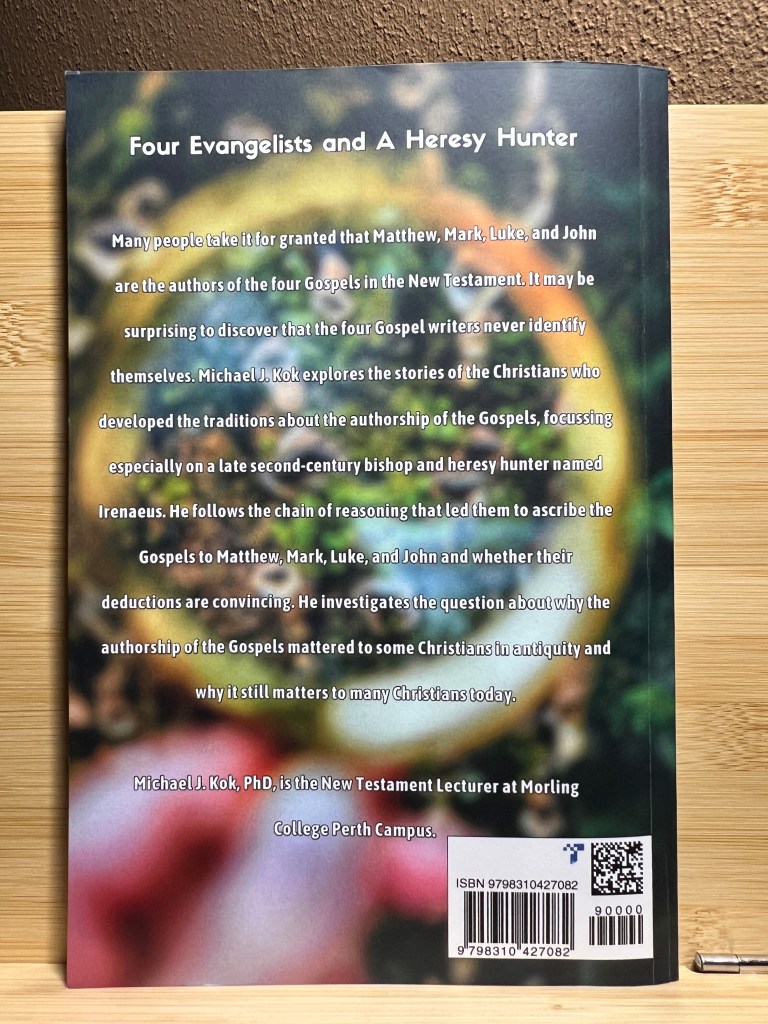
Michael J. Kok, Four Evangelists and a Heresy Hunter: Investigating the Traditions about Matthew, Mark, Luke, and John. Self-published, 2025. Pp. 111. Paperback. $7.00. ISBN 9798310427082.
INTRODUCTION1
Four zones of the world and four winds blowing over them and therefore, reasoned Irenaeus, four Gospels (Haer. 3.11.8.). But which four and why? The traditional authorship of the Gospels, championed by that bishop of Lyon at the end of the second century CE, is the subject of Michael Kok’s latest book Four Evangelists and a Heresy Hunter: Investigating the Traditions about Matthew, Mark, Luke, and John. Kok, a New Testament lecturer at Morling College in Australia, is the author of three previous books on the canonical Gospels: The Gospel on the Margins: The Reception of Mark in the Second Century (Fortress Press, 2015), The Beloved Apostle? The Transformation of the Apostle John into the Fourth Evangelist (Cascade Books, 2017), and Tax Collector to Gospel Writer: Patristic Traditions about the Evangelist Matthew (Fortress Press, 2023). In Four Evangelists and a Heresy Hunter, Kok treads familiar ground but sets it in the context of the work of Irenaeus, the bishop of Lyon, who in the second century C.E. wrote the multi-volume work Against Heresies (i.e., Haer.).

SUMMARY
Beginning with the introduction, Kok presents to his readers Irenaeus’s defense of the fourfold Gospel as it appears in Against Heresies. He also discusses issues surrounding the titles of the canonical Gospels, the meaning and import of the term “gospel,” and the purpose of his volume which is, per Kok, “to equip readers to assess the arguments for and against the traditional authorship of the four Gospels in the New Testament” (p. 11). To that end, ch. 1 features a look at the Gospel of Matthew as it relates to Irenaeus’s claims that it was written by the Evangelist in the language of his native audience, i.e., Aramaic (or possibly Hebrew). Relying on the (sound) consensus that the Matthean author relied on the Gospel of Mark, he argues against Irenaeus’s view before moving on to the tradition about Matthew’s Gospel found in the writings of Papias as well as the so-called “Gospel according to the Hebrews” mentioned by Origen.
In ch. 2, Kok turns his attention to the Gospel of Mark, a text that Papias had claimed was rooted in the preaching of Peter and that Irenaeus believed was written after Peter was already dead and gone. Our author examines not only the portrayal of Peter in the Markan narrative but he also looks at the relationship between Mark and Peter as we find it in the canonical New Testament. Additionally, he probes the Papian tradition, both in terms of its fountainhead, the mysterious John the Elder, as well as its content, especially the problems John (and, by extension, Papias) found with Mark’s work. Chapter 3 covers Luke’s Gospel, beginning first with the “We Passages” from the Acts of the Apostles and who exactly the individual standing behind the first person plural pronoun may have been. The end of that chapter is an interesting discussion of the reception of the third Gospel, not only among men like Irenaeus and Tertullian but also Marcion.
The Gospel of John is the focus of ch. 4 and Kok looks at the “beloved disciple” as he appears in the Fourth Gospel and who he (or she) may have been. In addition to this, our author looks at how Irenaeus talks about John the disciple, a man he conflates with John the Elder, a figure known to Irenaeus’s teacher Polycarp as well as to Papias. In ch. 5, Kok gives readers an overview of the life and thought of Irenaeus, documenting in brief some of the disputes to which he was party. The volume’s concluding chapter affirms the formal anonymity of the Gospels, acknowledging that this in-and-of itself does not mean there is no eyewitness testimony contained in these canonical texts. Rather, the situation is more complicated and it is up to readers “to decide what the evidence suggests” concerning traditions about authorship (p. 102).
REACTION
There is nothing groundbreaking in Four Evangelists and a Heresy Hunter, nor will readers find any citations to secondary sources. And this is as it should be. Kok delivers an excellent prelude to a deeper study into the canonical Gospels and their authorship, summarizing charitably the traditional case for authorship as we find it in the writings of various church fathers, especially Irenaeus. This has the advantage of giving the audience a stripped down and historically rooted analysis. An additional benefit of this approach is that it avoids the kinds of jargon that can alienate readers who perhaps are not well-versed in New Testament scholarship. Greek and Hebrew terms are transliterated and the arguments are simple to follow.
Of particular interest to me was his chapter on the Gospel of Luke. As I already noted, Kok has written volumes on Matthew, Mark, and John. To date, he has not delivered one on the Gospel of Luke. So, it was with great interest that I read this particular section, eager to not only uncover his thoughts on the subject but also to stir hope that this chapter would represent a kind of down payment on a larger future installment on Luke-Acts. He begins (of course) with Irenaeus who had written, “Luke also, the companion of Paul, recorded in a book the Gospel preached by him” (Haer 3.1.1).2 It is Irenaeus who first connects the dots between the We-Passages of the Acts of the Apostles3 to Luke the physician from the Pauline epistles.4 Citing the various We-Passages, he wrote, “As Luke was present at all these occurrences, he carefully noted them down in writing, so that he cannot be convicted of falsehood or boastfulness, because all these [particulars] proved both that he was senior to all those who now teach otherwise, and that he was not ignorant of the truth” (Haer 3.14.1). But is Irenaeus’s assessment correct?
One of the issues with tying Luke, a purported companion of Paul and eyewitness to events in Paul’s life, to the authorship of Acts is that there are places where the book of Acts and Paul’s letters seem to conflict. For example, after his encounter with Jesus did he remain in Damascus for some time as Acts 9:19 and 23 narrate or did he go to Arabia and then returned to Damascus as Paul asserts in Gal 1:17? Did Paul go to Jerusalem not long after his encounter with Jesus as Acts 9:23-26 suggests or did he wait three years as Gal 1:18 claims? Did Paul meet with the disciples, a term that in Luke-Acts refers to the Twelve, as Acts 9:26-28 states or did he meet only with Peter (i.e., Cephas) and Jesus’s brother James as Gal 1:18-19 reports? More examples could be produced but it suffices to say that there is some conflict between what the Lukan narrator claims about Paul’s biography and what Paul himself does in his extant letters.
Such conflict does not, of course, mean Acts is utterly unreliable and useless for historical reconstruction. It should, rather, be viewed as a secondary source when framing the life of Paul.5 As Christopher Mount writes, “Simply repeating the story of Acts is not historiography.”6 Thus, simply taking the We-Passages at face-value is problematic. Nor does treating them as eye-witness accounts exhaust all our interpretive options, as Kok notes.7 Additionally, there are good reasons for thinking that the book of Acts was written sometime at the end of the first century or in the oughts (or, perhaps, even later) of the second.8 If this is the case, Kok notes, the idea that Luke-Acts was written by a coworker of Paul is less likely.
Regardless, what is even more important is the reception of Luke-Acts among the earliest Christ-followers. This includes such reviled characters as Marcion, the second century bishop who strove to divorce Christianity from its Jewish origins.9 Marcion, whose ideas survive only in the writings of his critics,10 rejected the Old Testament and read from a primordial version of the New Testament that contained a version of the Gospel of Luke that apparently lacked the infancy narrative11 as well as a selection of Paul’s letters. Irenaeus targeted Marcion, claiming that he “mutilates the Gospel which is according to Luke, removing all that is written respecting the generation of the Lord [i.e., the nativity], and setting aside a great deal of the teaching of the Lord, in which the Lord is recorded as most dearly confessing that the Maker of this universe is His Father” (Haer. 1.27.2). Kok notes that this claim by Irenaeus as well as those made by other critics of Marcion, “are hardly objective. If they were more charitable, they might have inferred that Marcion inherited a version of Luke’s Gospel…that was missing its opening chapters for whatever reason” (p. 64). Especially interesting is a point relevant to the authorship of the third Gospel: Marcion’s version of Luke lacked any title that revealed its author. Writes Tertullian, “Marcion…ascribes no author to his Gospel, as if it could not be allowed him to affix a title to that from which it was no crime (in his eyes) to subvert the very body” (Marc. 4.2).12 Whence this omission?
Kok observes that Justin Martyr, a person esteemed by Irenaeus, never named the Evangelists as we know them, though he did refer to the Gospels as apostolic “memoirs” (1 Apol. 67).13 Additionally, in his Dialogue with Trypho, Justin may attribute to Peter material from the Gospel of Mark (Dial. 106), though, as Kok notes, “the Greek text is a little unclear on this point” (p. 68).14 In any event, the key takeaway is that with regards to the Gospel of Luke we have one Christian who has an anonymous version of the text and another who includes it as part of the collective memories of the apostles. It is Irenaeus who is the first to point to Luke as the Gospel’s author, doing so on problematic grounds.
CONCLUSION
Though there is nothing novel about Kok’s latest book, it is nevertheless an incredibly valuable and accessible resource on the traditional authorship of the Gospels. It is a volume that could easily be read in a single day and, for more curious readers, there is a website where readers can find secondary sources to supplement.15 And while the volume is self-published, it comes from a respected scholar of the New Testament who has been published in major journals and by major publishers. It is also only $7.00 and therefore incredibly affordable!
- Throughout the endnotes readers will find various abbreviations. For a list of what abbreviations I use and the works to which they refer, please see the page “Commonly Used Abbreviations.” ↩︎
- All translations from Irenaeus are taken from ANF 1. ↩︎
- Acts 16:10-17; 20:5-15; 21:1-18; 27:1-29; 28:1-16. ↩︎
- Phlm 1:24, Col 4:14, 2 Tim 4:11. ↩︎
- So J. Albert Harrill, Paul the Apostle: His Life and Legacy in Their Roman Context (Cambridge University Press, 2012), 11. For an example of a judicious use of Acts as a source for Paul’s life, see Calvin Roetzel, Paul: The Man and the Myth (Fortress Press, 1997), 11-19. ↩︎
- Christopher Mount, “Acts,” in T&T Clark Handbook to the Historical Paul, edited by Ryan S. Schellenberg and Heidi Wendt (T&T Clark, 2022), 26. Mount, looking at Paul’s autobiography in Galatians 1 and the Lukan biography in Acts 8-15 notes that the differences between the two amount to intentional rhetorical interpretations: Paul wants to demonstrate his independence from the apostles and the Lukan author wants to demonstrate his fealty. See Mount, “Acts,” 34-35. ↩︎
- For more on the We-Passages, see, e.g., Gerd Theissen, The New Testament: A Literary History (Fortress Press, 2012), 188; Richard I. Pervo, Acts: A Commentary, Hermeneia (Fortress Press, 2009), 392-396; Vernon K. Robbins, “By Land and By Sea: The We-Passages and Ancient Sea Voyages,” in Perspectives on Luke-Acts, edited by C.H. Talbert (Mercer University Press and T&T Clark, 1978), 215-242; Willian Sanger Campbell, The “We” Passages in the Acts of the Apostles: The Narrator as Narrative Character, SBLStBL 14 (Society of Biblical Literature, 2007). ↩︎
- On the dating of Acts, see, e.g., Mikeal C. Parsons, Acts, Paideia (Baker Academic, 2008), 16-17; Barbara Shellard, New Light on Luke: Its Purpose, Sources and Literary Context, JSNTSup 215 (Sheffield Academic Press, 2002), 23-34; Richard I. Pervo, Dating Acts: Between the Evangelists and the Apologists (Polebridge Press, 2006). ↩︎
- Marcion as sometimes been referred to as a “gnostic,” but, as Diarmaid MacCulloch (Christianity: The First Three Thousand Years [Viking, 2009], 126) observes, this is a misunderstanding. Though he certainly shared affinities with so-called gnostics, he was not a “gnostic.” On the problems with “Gnosticism,” see Erin Vearncombe, Brandon Scott, and Hal Taussig, After Jesus Before Christianity: A Historical Exploration of the First Two Centuries of Jesus Movements (HarperCollins, 2021), 216-231. See further Michael Allen Williams, Rethinking “Gnosticism”: An Argument for Dismantling a Dubious Category (Princeton University Press, 1996). Williams discusses Marcion specifically (pp. 23-26) as an example that some have proffered of gnostics. But, he notes, scholars have been leery to label him as such; he is “a problematic case” (p. 26). And this, he continues, functions as a kind of probe into how useful the category of gnostic truly is: “[T]he arguments that are often marshaled for distinguishing Marcion from ‘gnosticism’ also mask a more fundamental problem: the category of ‘gnosticism’ itself” (p. 27). ↩︎
- For an overview of Marcion’s beliefs, see David Brakke, The Gnostics: Myth, Ritual, and Diversity in Early Christianity (Harvard University Press, 2010), 96-99. ↩︎
- On Marcion’s version of the Gospel of Luke, see Bruce M. Metzger, The Canon of the New Testament: Its Origins, Development, and Significance (Oxford University Press, 1987), 92-93; Heikki Räisänen, “Marcion,” in A Companion to Second-Century Christian “Heretics,” edited by Antti Marjanen and Petri Luomanen, VCSup 76 (Brill, 2005), 113-116. ↩︎
- Translation taken from ANF 3. ↩︎
- Cf. Bart D. Ehrman, Jesus before the Gospels: How the Earliest Christians Remembered, Changed, and Invented Their Stories of the Savior (HarperOne, 2016), 118-119. ↩︎
- Metzger (The Canon of the New Testament, 145) thought Justin was definitely referring to Peter and that, in so doing he was “doubtless alluding to the tradition reported by Papias that Mark wrote down Peter’s words.” ↩︎
- www.fourevangelistsandaheresyhunter.wordpress.com. Accessed 9/11/25. ↩︎
 The Amateur Exegete
2 thoughts on “‘Four Evangelists and a Heresy Hunter’ by Michael Kok – A Review”