“‘Christianity.’ ‘The faith.’ ‘The church.’ By using these terms in the singular, we repeat the rhetoric of the retrospectively ‘orthodox,’ and we obscure the vital variety that always characterized this protean movement.”
– Paula Fredriksen, Ancient Christianities: The First Five Hundred Years (Princeton University Press, 2024), 198.
- Robyn Faith Walsh talks the “real” Paul over at the YouTube channel Bible & Archaeology. We have some of Paul’s correspondence with various communities and we have interpretations of Paul in second century works like the Acts of the Apostles or the Acts of Paul. Walsh does a great job of unpacking some of this. She also hints at some of her future research.
- Charles Hedrick looks at the mythological Tartarus in the New Testament and its implications.
- I just noticed that the latest issue of Novum Testamentum has a couple of open access articles, including a piece by Nicholas Moore on the epistle of Jude and the Watchers from the book of 1 Enoch.
- Paul Davidson has a new video out, this time on cherubim. It’s really informative!
- In the above video, Davidson quotes from Esther Hamori’s excellent book God’s Monsters. And wouldn’t you know, Hamori was recently interviewed about sea monsters in the Bible!
- In response to an op-ed in The New York Times that compares Donald Trump to a pagan king due to his largely immoral and ethically rudderless “might makes right” philosophy of governing instead of a more “Christian” one, Stephen Young notes that this is far too simplistic and that the Bible has its share of problems too, from genocide to sexual slavery to sexual violence generally. (It’s why I tend to shudder when I hear people get their morality from the Bible because it usually means they’ve never read it fully.)
- Need some reading material? The articles in the Journal of Greco-Roman Christianity and Judaism are available for free! (HT: Ekaterini Tsalampouni.)
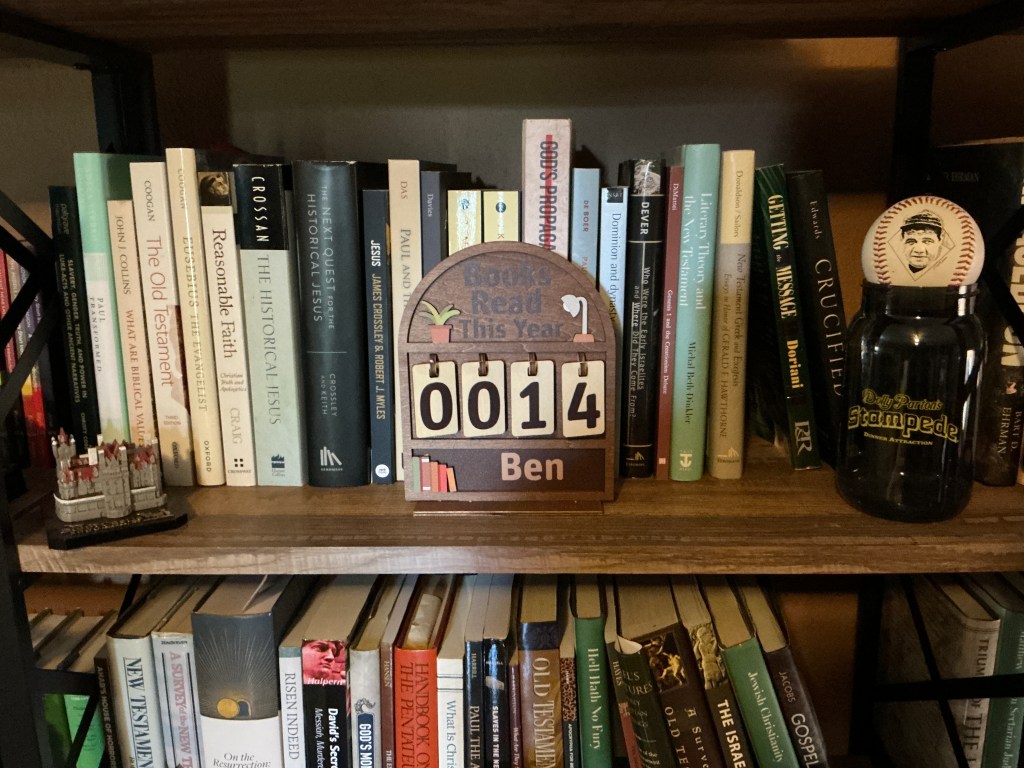
- I’m reading!
 The Amateur Exegete
Hamori raises a good question about how many (most?) of us don’t notice or recall the conspicuous creation of “the great sea monsters” (התנינם הגדלים, hattanninim haggedolim) in Gen 1:21–surely a memorable image.
Gotta wonder if a key cause of our semi-ignorance/amnesia is at least partially a function of the translations to which we’ve been exposed, especially as kids. The more traditional, orthodox-inclined translators seem to have been uneasy with the implications of Elohim releasing the krakens and cthulhus and whatnot. So the KJV gives us “the great whales”–cool, but somewhat forgettable. The NIV is even blander, with “the great creatures of the sea.”
More modern, scholarly translations (JPS, NRSV, NABRE, among others), likely drawing in part on what we’ve learned about the תנינם in Canaanite/Ugaritic and Babylonian sea myths in the past century or two, have the good stuff: “the great sea monsters.”
(Happy to say I have a copy of God’s Monsters; embarrassed to say I haven’t read it yet.)
LikeLike