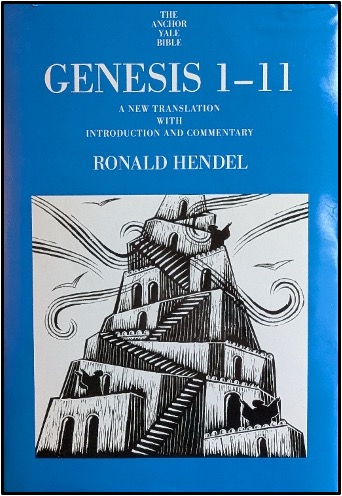
Ronald Hendel. Genesis 1-11: A New Translation with Introduction and Commentary. Yale University Press, 2024. Hardcover. $85. Pp. xv + 466. ISBN 978-0-300-14973-9.
Introduction
In this masterful recent contribution to the Anchor Yale Bible Commentaries, Ron Hendel translates and analyzes the first eleven chapters of Genesis—the “Primeval History” of Creation and the Fall, the first murder, the Flood, the Tower of Babel, and cryptic figures such as the Nephilim and Nimrod. Hendel, now a Professor Emeritus affiliated with UC Berkeley’s Center for Jewish Studies, approaches the scripture from a variety of scholarly angles—anthropological, historical, linguistic, and literary—in this comprehensive volume. Yet Genesis 1-11 is no dry, clinical, ponderous tome. Hendel tells the story of these stories with the enthusiasm of a teacher who genuinely enjoys the job; his affection for the text and admiration for its authors are obvious and infectious.
A Very Good Place to Start
The book’s first section explores helpful background details. We read about the key manuscript traditions from which modern editions and translations of Genesis spring: the Hebrew Masoretic Text, the Greek Septuagint, the Samaritan Pentateuch, and fragmentary writings from the Dead Sea Scrolls. Hendel summarizes the elements of source critical scholarship relevant to Genesis 1-11, in which he and other mainstream experts see the work of the Priestly (P) and Yahwist (J) (or non-P) sources, as arranged and integrated by a Redactor (R).
He also considers the likely period of composition and, in a move sure to displease both minimalists who advocate for a late 1st millennium BCE date and maximalists fond of orthodox notions of Mosaic authorship in the last half of the 2nd-millenium BCE, steers a middle course. The vocabulary, syntax, morphology, and phonology of the texts lead Hendel to date the J material to the 9th to 7th centuries BCE, and P to the late 7thto early 5th centuries BCE.
Hendel next discusses the genealogical, mythological, and moral dimensions of Genesis, as well as its reception and interpretation in the millennia since its composition.
Finally, we get a useful primer on the broader historical and cultural context of the Ancient Near East and discernable influences on ancient Hebrew writers. These influences, including both Egyptian and Mesopotamian traditions, surface frequently throughout the rest of Genesis 1-11 in discussions about shared (or at least notably similar) motifs and events.
Nerd Alert
A thorough, thirty-page bibliography follows the introductory background section. That I will never have time to consume all these publications (and wouldn’t even understand those in French) did little to diminish the pleasure of finding this roadmap for further research. My wife now has gift ideas for every birthday and holiday until I shuffle off to Sheol.
In English, Please
The book’s subtitle promises a “new translation,” and Hendel finally delivers about ninety pages in. Here we read a skillful, dynamic rendering of Genesis 1-11, with different typefaces to distinguish the content generally attributed to P, J, and R. Hendel takes pains to convey the meaning of the underlying Hebrew text as faithfully as possible, but without any of the wooden awkwardness that can make literal-leaning efforts a chore to endure. This is a flowing, thoughtful translation crafted for the modern reader.
Translations and Commentaries
The remainder of Genesis 1-11 separates this translation (with corresponding commentary) into eleven muscular chapters. Hendel organizes the material not by modern biblical chapters, which do not always align with the narratives, but rather by the narratives themselves. So we get the following sensible structure:
- six-day Creation (1:1-2:3)
- (second) Creation, the Garden, and the Fall (2:4-3:24)
- Cain and Abel (4:1-26)
- genealogy from Adam to Noah (5:1-32)
- the Sons of the Elohim and daughters of men (6:1-4)
- Noah and the Flood according to J (6:5-8:22)
- Noah and the Flood according to P (6:9-9:29)
- curse of Canaan (9:18-27)
- Table of Nations (10:1-32)
- Tower of Babel (11:1-9)
- genealogy from Shem to Abram/Abraham (11:10-32)
Each chapter consists of a translated story and then specific commentary in three parts. First, Hendel provides concise “Textual Notes” highlighting material elements of (and discrepancies between) the key manuscript traditions. Second come abundant “Notes” conveying a wealth of linguistic and literary insights on a painstaking verse-by-verse (sometimes clause-by-clause) basis. Third and finally, we have “Comments,” which are essays consisting of more wholistic, big-picture analyses.
The commentary is eclectic and scholarly, yet accessible. When sharing thoughts about etymology, word play, and other linguistic points, Hendel does not assume any level of Hebrew fluency on the part of his readers. He explains things in clear English, with important biblical Hebrew words and phrases rendered in user-friendly Latin alphabetic transliterations. Comparisons to Egyptian and Mesopotamian tales and notions abound, written in a manner that illuminates the alignments and misalignments with the biblical text, and does not obscure Hendel’s ideas on cultural cross-pollination behind a tangle of unnecessary academic jargon.
Perhaps more than anything else, the commentary in Genesis 1-11 is literary and humane. Hendel examines the narrative devices, rhetorical techniques, and poetic elements of the stories that so often suffer in translation, and that are largely muted or absent in the Sunday school versions with which most of us are familiar. In telling us what he thinks about each passage, character, conflict, and catharsis, Hendel simultaneously invites us to think along with him, to better understand the authors’ engagement with their world and the human condition.
Complaint Department
Surprisingly, Genesis 1-11 contains no modern-style maps, and I found myself itching to refer to one at times for geographic clarity. The biblical text mentions places and features readers might wish to locate with confidence, and Hendel’s discussions of the various peoples, cultures, and placenames of the ANE would have benefited from a couple of convenient visual aids. (To be fair, the chapter on the Table of Nations includes a fascinating little map of the known world as reckoned by the ancient authors, but that’s of limited practical utility, and more reminiscent of Tolkien than Rand McNally.)
Along similar lines, the relative paucity of illustrations in a book of this density was a bit disappointing. To be sure, my statement is not merely a complaint, but also a sincere compliment on the artistic abilities of Hendel’s fellow scholar, William Propp. The dozen or so splendid drawings we do find in Genesis 1-11—of artifacts, bas-reliefs, etc.—are all Propp’s doing. And I would love to have seen more.
Conclusion
Genesis 1-11 is a marvelous book I’ll be consulting for years. Any clergy, scholar, or amateur deeply interested in Genesis, and especially the Primeval History, will find Genesis 1-11 a worthwhile read and reference work. In that recommendation hides a caveat: this is not a book for casual consumption. While far less technical than Hendel’s 1998 volume, The Text of Genesis 1-11: Textual Studies and Critical Edition, Genesis 1-11 is a thorough, impassioned, penetrating exercise in expository scholarship that requires—and rewards—time and attention.
 The Amateur Exegete