Here are a few of the books, articles, YouTube videos, and more that I’ve read (or, at least, acquired) over the past couple of months.
In Memoriam
- Walter Brueggemann passed away June 5 at the age of 92. I have profited greatly from the commentary on the Psalms he wrote with William Bellinger for the New Cambridge Bible Commentary series and refer to it often when I need scholarly insight into the Psalter. He will be missed.
Books, Articles, & Reviews
- Recent arrivals:
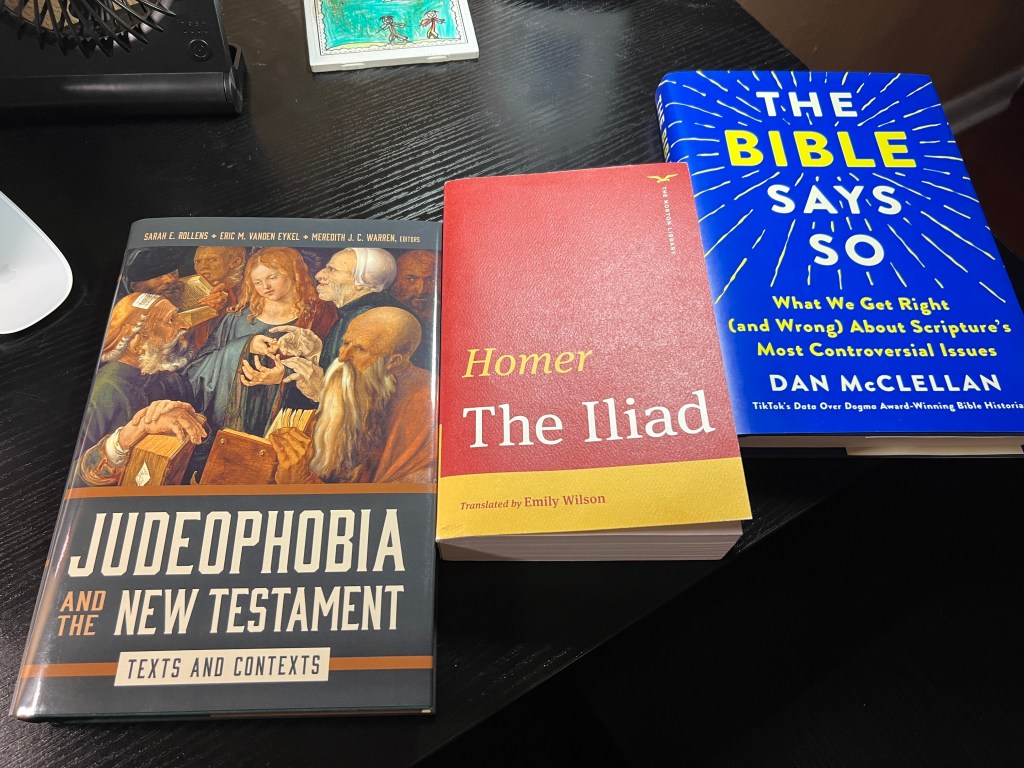
- Judeophobia and the New Testament: Texts and Contexts, edited by Sarah E. Rollens, Eric M. Vanden Eykel, and Meredith J.C. Warren (Eerdmans, 2025).
- Richard Carwardine, Righteous Strife: How Warring Religious Nationalists Forged Lincoln’s Union (Knopf, 2025).
- Dan McClellan, The Bible Says So: What We Get Right (and Wrong) about Scripture’s Most Controversial Issues (MacMillan, 2025).
- Homer, The Iliad, translated by Emily Wilson, The Norton Library (W.W. Norton & Co., 2025).
- Joshua Lee Waddell has a review of Richard Carwardine’s recent book Righteous Strife: How Warring Religious Nationalists Forged Lincoln’s Union. You can find it at The Civil War Monitor website.
- You can check out my review of James McGrath’s book The A to Z of the New Testament over at my website!
YouTube
- Lachlan of the YouTube channel Tablets and Temples has a series of videos on changes made in biblical texts, whether it is in the Dead Sea Scrolls, the LXX, or from manuscript to manuscript. Below is the first video in that series.
- Need a crash course on the cosmology of ancient Israel? Paul Davidson has a well-put together video on the subject over at his channel!
- Andrew Mark Henry’s channel Religion for Breakfast has surpassed one million subscribers! That’s amazing!

- Did Paul know about the empty tomb? William Lane Craig says yes, but YouTuber HatsoffHistory thinks Craig is dead wrong.
- Dan McClellan recommends some resources for critical biblical studies. They are excellent suggestions. (Some of them I’ve highlighted in my “Amateur’s Toolbox” series for the podcast Bible Study for Amateurs.)
- Mark Goodacre talks about why the Synoptics are so similar in a recent interview.
- Matthew Goff and Dylan Burns talk with Shirley Paulson about the relationship between the Dead Sea Scrolls and the Nag Hammadi Library.
- Should you take atheists seriously? The Non-Alchemist says yes, but argues that atheists don’t get some Get Out of Jail Free card on account of their disbelief.
Blog Posts
- Marg Mowczko has posted a helpful list of the 29 people Paul mentions in Romans 16 as well as brief notes on a number of them. The list, she writes, “gives insight into the church in Rome, and it reveals Paul’s esteem and regard for some of the believers there.” Check it out!
- Why did Uzza die when he touched the ark of the convent? David Glatt-Gilad talks about it in a recent entry for thetorah.com. As it turns out, the Deuteronomistic Historian and the Chronicler have slightly different takes.
- Apologist Wesley Huff thinks that the every chapter in the Gospel of Mark portrays Jesus is God. Mark Edward shows that not only does Huff skip a whole bunch of chapters but his analysis is far from correct.
- Some Christians argue that Matthew 1:25’s “until” (Greek, eōs) should not be read to mean Mary had children in addition to Jesus. Travis Wright thinks that this reading is wrong and links to a paper he recently wrote on the subject.
- John Nelson talks about the mass resurrection the Matthean Evangelist reports following Jesus’s death. Nelson looks at the arguments surrounding the passage made by Michael Licona, James Crossley, N.T. Wright, and others.
 The Amateur Exegete
Hmm. Might have to pick up that book on Judeophobia and the NT. The subject is compelling and problematic, and the list of contributors is impressive.
Coincidentally, my wife and I just got back from a vacation in Rome, where we spent a fair amount of time in the Jewish Quarter. Nowadays, it’s a thriving, lively neighborhood with good restaurants and a magnificent, architecturally eclectic synagogue, but from from around 1550 until the fall of the Papal States in 1870, the area was a squalid, cramped, walled ghetto mandated by Team Vatican–an appalling case study in anti-Jewish segregation, discrimination, and maltreatment. Rhetoric used by Church authorities (up to and including a few popes) to justify this system routinely invoked the NT to characterize Jews as perfidious, obstinate, malign deicides from whom decent, upstanding Catholics needed protection.
To their credit, several modern Church leaders have condemned and apologized for that whole state of affairs. But it is astonishing to consider that for several centuries in the heart of Christianity’s most durable, full-on theocracy, official policy toward Jews was not entirely unlike a Candace Owens rant.
–Lex Lata
LikeLiked by 1 person