Irrefutable Scientific Evidences for the Historicity of the Epic of Gilgamesh
Guest post by Lex Lata, Parody Apologist
Modern atheists contend that the Epic of Gilgamesh is mythological poetry—simply a legendary tale about the adventures of a fictional superhero in the days of yore. But as we shall see, the modern sciences of archaeology, biology, and geology confirm the historicity of the Epic, time and time again, soundly refuting the opinions of secular so-called “scholars” and the cynical skeptics who cite them.
The brick-walled city of Uruk
Go up on to the wall of Uruk and walk around!
Inspect the foundation platform and scrutinize the brickwork!
Testify that its bricks are baked bricks . . . .1
The Epic is no mere fantasy story that took place in the Sumerian equivalent of Narnia or Neverland. In 1849, renowned British geologist, explorer, and archaeologist William Kennett Loftus identified the site of Gilgamesh’s very real city of Uruk, establishing beyond doubt a critical element of the narrative’s geographical setting in Mesopotamia. And what’s more, excavations at Uruk have revealed the unmistakable presence of baked mud bricks, corroborating the Epic in amazing architectural detail.
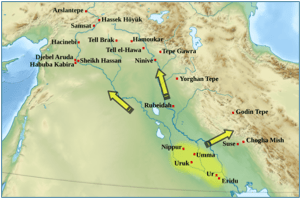
Uruk expansion and colonial outposts, ca. 3600-3200 BCE
(Source: Wikimedia Commons)
Lapis lazuli tablets
Lift out the lapis lazuli tablet and read it . . . .2
Skeptics might scoff that lapis lazuli is a precious stone suitable only for jewelry and other ornamental purposes. But archaeologists have, indeed, found ancient Mesopotamian tablets of inscribed lapis lazuli, such as the 25th century BCE foundation tablet at the British Museum and a later tablet of Ashurbanipal, exactly as the Epic describes. To date we have not discovered contemporaneous lapis lazuli tablets recounting Gilgamesh’s exploits specifically, but there is no cause to deny such tablets once existed, and they might yet surface in some future dig.
The real King Gilgamesh
There is nobody among the kings of teeming humanity
Who can compare with him,
Who can say “I am king” besides Gilgamesh.3
Hyper-rationalist Gilgamesh mythicists have claimed that no such person ever existed, and that he was just a legendary figment of the ancient imagination. The Sumerian King List confirms, however, that a real man named Gilgamesh was among the earliest rulers of Uruk, ca. 2900-2500 BCE. In addition, the Gilgamesh and Aga tablets describe (albeit in poetic form) the political and military conflict between Gilgamesh and the known, historical King Aga of Kish. Archaeology proves the doubters wrong, once again.

Gilgamesh in sculptured vase, ca. 2600-2300 BCE
(Source: Wikimedia Commons)
Historically accurate fauna
With gazelles he eats vegetation,
With cattle he quenches his thirst at the watering place.4
. . . .
I killed a bear, hyena, lion, leopard, tiger, deer, mountain goat, cattle, and other wild beasts of the open country.5
Some skeptics will point to the scarcity and even absence of several of these animals in modern Mesopotamia, and claim that the references are therefore just fanciful embellishments. But habitat ranges can shift enormously over time, and science tells us the Epic’s author was uncannily familiar with animals of the Ancient Near East. A few examples:
- Wild gazelle was a valued game animal depicted in Sumerian artifacts.
- Cattle were among the earliest domesticated animals in ancient Mesopotamia.
- The region was also once home to Syrian brown bears, striped hyenas, Asiatic lions, and other animals appearing in the Epic.
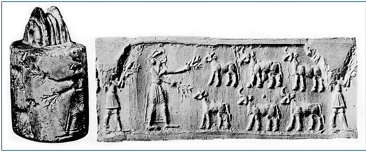
Cylinder seal of Uruk-period priest-king feeding sacred herd of cattle, ca. 3200 BC
(Source: Wikimedia Commons)
Mount Hermon and the cedars of Lebanon
Sirara and Lebanon were split apart in their gyrations . . . .6
The Epic describes the arduous expedition of Gilgamesh and his friend Enkidu to the land of Lebanon and Sirara, where they plan to battle the monstrous Humbaba and harvest cedars. History massively confirms that Lebanon was a famed source of prized cedar wood in the Ancient Near East, and that Sirara was an archaic name for modern Mount Hermon.7 Just as with Uruk, the Epic perfectly reflects the geography of the Ancient Near East with its references to Lebanon and Sirara.
Bitumen-sealed boat
I saw to the paddles and put down what was needed:
Three sar of bitumen I poured into the kiln,
Three sar of pitch I poured into the inside8
The Epic includes a detailed description of a reed boat waterproofed with bitumen—a crucial, naturally occurring substance readily available in ancient Mesopotamia—in anticipation of a catastrophic divine flood. And once again, modern archaeology overwhelmingly corroborates what we read in the Epic. Only a few years ago, excavations at Uruk revealed a 4,000-year-old boat that had been covered in bitumen!

Modern bitumen-sealed quffa (kuphar) in Baghdad, 1914
(Source: Wikimedia Commons)
* * *
And so on. Contrary to the ignorant arguments of the nonbelieving naysayers, scientific disciplines such as archaeology provide plentiful proof for the historicity of the Epic of Gilgamesh.
 The Amateur Exegete
Hey Ben, do you got Kipp Davis’ new book yet?
LikeLike
I just got it last week! I’ve not read it yet. But I hope to soon and (possibly) write a review.
LikeLike
parody apologetics, this is gold, ha ha.
LikeLiked by 1 person
Ben, have you read any N.T. Wright books?
LikeLike
I read a couple years ago, his ‘The Resurrection of the Son of God’ and another on Paul.
LikeLike
What did you think of his arguments about the resurrection?
LikeLike
I think at the time I probably found them convincing. What Wright does well is to craft an argument and supply a lot of documentation. He’s well-versed in the literature. It’s been well over a decade since I’ve really engaged with his work, though. I’ve forgotten a lot.
LikeLike
The book you read about Paul—was it a biography or Paul and the Faithfulness of God?
LikeLike
It wasn’t his ‘Paul and the Faithfulness of God.’ I haven’t read that one yet. (I don’t really plan to either.) If memory serves it was his ‘Paul and His Recent Interpreters.’
LikeLike
An Excellent (and Funny) Piece! Have you considered making a series out of these parody articles? It’d be cool to see someone try to “defend” the historical veracity of the Trojan War episodes in Greek Mythology, the Thousand and One Nights, or even the Nibelungenlied. (“Why won’t skeptics accept the deeds of Achilles or the Judgement of Paris? Schliemann et al.’s work on what turned out to be the site of Troy showed that a force from the Balkans could have attacked the supposedly mythical city and the time frame of the razing is compatible with the period described in the Homeric epics…”)
LikeLike