Note: This will be the final Roundup until September. Between the kids’ summer break, vacation, and everything else under the (blazing hot) sun, I don’t think I’ll have much time to put it together until school starts back in a few months. So, for those of you in the Northern Hemisphere, have a great summer. For those of you below the equator, good luck!
- CJ Cornthwaite (why is that last name so hard for me to spell?!?) talks about a really bad argument that apologists proffer for the New Testament’s reliability/accuracy. He notes, importantly, that things are often far more complicated that the apologists would have you believe.
- Claude Mariottini writes about the rape of Dinah from Gen. 34 and its aftermath. This story always strikes me as grotesque, mostly because of Jacob’s reaction to it all. Giving your daughter as wife to her rapist is beyond the pale, and while I do not condone revenge, his reaction to his sons’ actions is also troubling. And add to that the question Simeon and Levi pose to their angry father: “Should our sister be treated like a prostitute?” Um, no. And you shouldn’t treat prostitutes poorly either. Ahhhh! This story is so frustrating!
- Erik Eykel has started a series of posts on the Shroud of Turin. The Shroud has always struck me as an oddity. As evidence for the resurrection of Jesus, it compels me not. The best evidence for the resurrection would be, you know, Jesus walking among us alive. And as Eykel notes, the Shroud isn’t really about evidence anyway, but about persuasion.
- Robyn Walsh asks whether non-canonical Gospels can tell us anything “new” about Jesus.
- Steve Wiggins is working on a bibliography for his blog. He laments all the books he didn’t discuss but that he read, something I can sympathize with totally. Books are life, indispensable for me as much as my own lungs.
- Mark Goodacre discusses the minor agreements between Matthew and Luke against Mark. On the hypothesis of their mutual independence, this seems problematic. And so either Matthew used Luke or (more likely) Luke used Matthew.
- I just discovered the website Balashon – Hebrew Language Detective. It’s run by David Curwin who, as he admits, is not a linguist but is a lifelong lover of the Hebrew language. You should check out his site as he has some rather interesting posts.
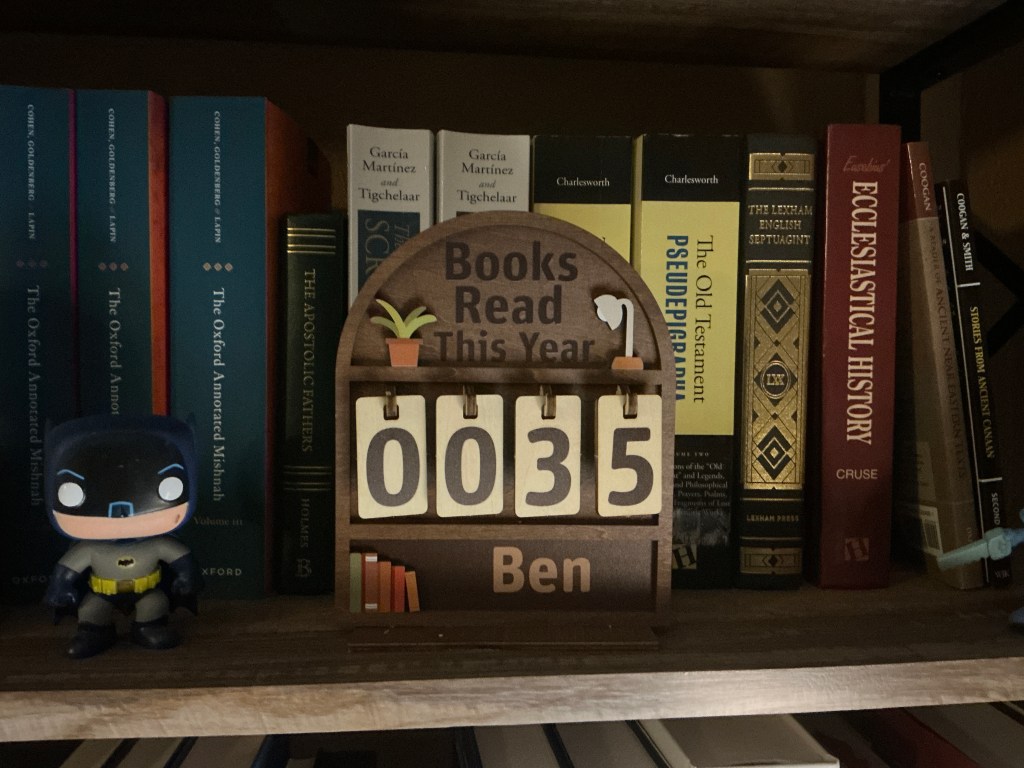
- 35 books and counting, baby!


Thanks for the new round-up.
On the Shroud of Turin, the two best arguments (to my mind) for its non-authenticity are that it was “discovered” in a medieval era when relics were all the rage (and liable to be faked) and the fact that its image of Jesus looks suspiciously similar to a northern European saint: Why should medieval artists know what Jesus “looked like” when no one in the ancient era could really figure it out?
With his penchant for scenic backgrounds, I wonder if anyone would be willing to make a parody of Where in the World is Carmen Sandiego? with Mark Goodacre. You could race to find a purported manuscript of Q. In a twist ending, the document would be revealed as nothing more than an early Christian document for procuring the best wine for Eucharist (as Goodacre smiles wryly in the background.) Then another scholar (say James McGrath or Robyn Walsh) could tease the player with another ancient manuscript, setting the stage for a sequel.
LikeLiked by 1 person
Yep, couldn’t agree more about the Shroud. To expand on your first point: no Gospel mentions anyone picking it up, the Book of Acts mentions nothing at all about the Shroud or its post-Resurrection movement, Paul tells us nothing, the Church Fathers tell us nothing, etc. There’s not just a vast gap in the physical chain of custody; there’s a comprehensive, conspicuous, centuries-long silence in the multitudinous accounts from authors who ought to have at least heard of such an astonishing relic.
LikeLiked by 1 person
Over at TheTorah.com, David Ilan just published a thorough, readable piece on the Tribe of Dan’s plausible connections to (perhaps even origins among) the Mycenean/Aegean/Anatolian Sea Peoples. A fun and fascinating assessment of the literary, linguistic, and archaeological evidence.
LikeLiked by 1 person