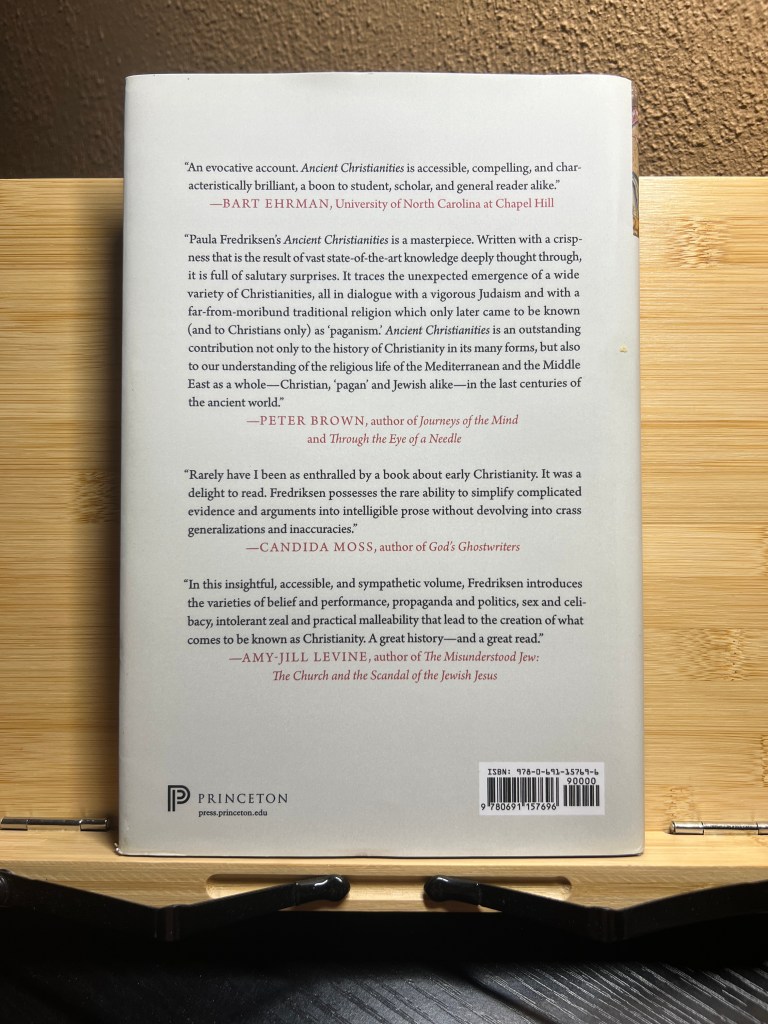
Paula Fredriksen. Ancient Christianities: The First Five Hundred Years. Princeton University Press, 2024. Hardcover. $29.95. Pp. 288. ISBN 9780691157696.
When I took my first church history class sometime around 2002 at Pensacola Christian College,1 the textbook was written from a dispensationalist perspective wherein the framework for studying Christian history was to be found in Jesus’s letters to the seven churches in Rev. 2-3.2 Needless to say, I learned very little. Since then, I’ve tried my best to shore up what I’ve missed, acquiring volumes like Bruce Shelley’s Church History in Plain Language, J.N.D. Kelly’s Early Christian Doctrines, Diarmaid MacCulloch’s Christianity: The First Three Thousand Years, Peter Heather’s Christendom: The Triumph of a Religion, AD 300 – 1300, and more. When I heard that Paula Fredriksen, undoubtedly my favorite historian of antiquity, was writing a book on the subject, I knew I had to get my hands on it.
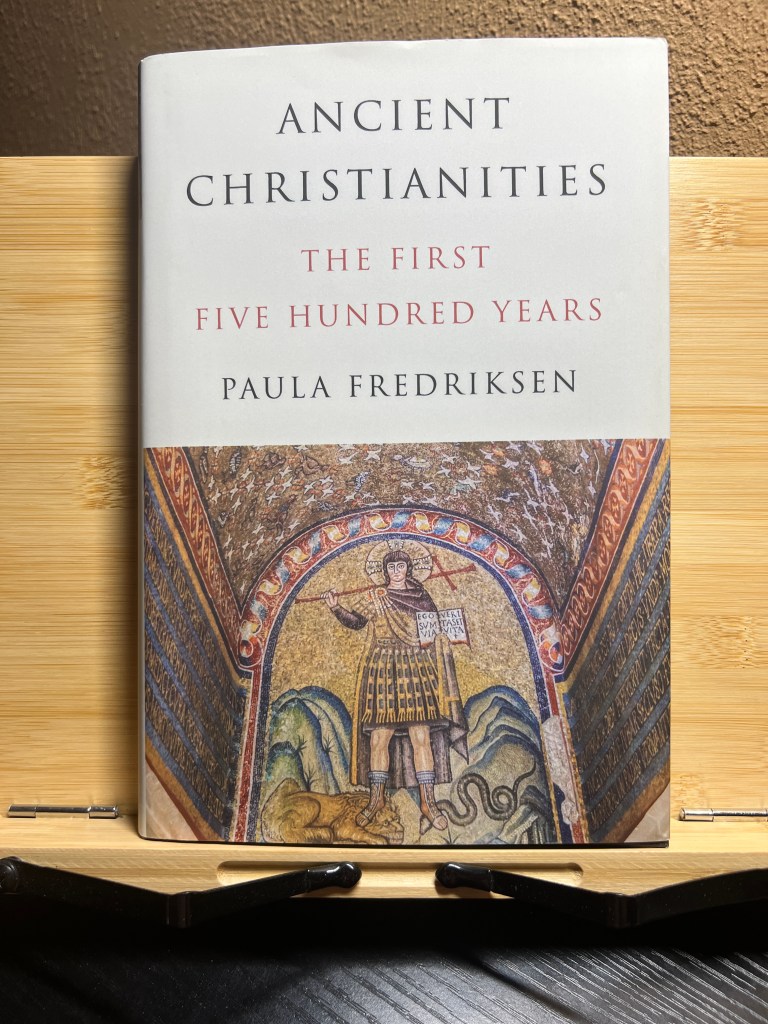
She begins in the volume’s preface by explaining that Ancient Christianities: The First Five Hundred Years, unlike so many histories of the Christian religion, is not chronological but thematic, serving as the means by which its author “introduce[s] the reader to the complexities and ambiguities, the ironies and surprises, the twists and turns of” (p. xiii) a story so textured and layered that, at least with respect to the author’s goals, a straightforward take just will not do. To that end, ch. 1 (“The Idea of Israel”) tracks the progress of the good news, rooted as it was in the teaching of a Palestinian Jew of the Second Temple period, into the Diaspora and, consequently into the proximity of non-Jews. The texts that resulted both from the reception of the gospel (little “g”) by non-Jews as well as the creation of narratives we refer to as Gospels (big “G”) were more often than not examples of intra-Jewish polemic but became, thanks to creative if not eisegetical readings of Jewish scripture, anti-Jewish in nature. By the second century CE, Jews became rhetorical punching bags, veritable straw men that could be conjured up by gentile Christians for a good thrashing. Israel, then, became something other than Israel.
Chapter 2 explores the diversity inherent in Christianity, beginning with the conflict between Paul and various interlocutors who were competing for authority among early Mediterranean assemblies. In time, the language of heresy was employed to target those with whom one had theological and political disagreements. Our author looks at Valentinus, Marcion, and Justin Martyr and the way in which words were weaponized by and against them. She also considers how heresiologists (e.g., Irenaeus) exerted control, not only by imputing to heretics beliefs that they often didn’t hold but also by creating texts that sought to reign in the impulses of so-called gnostics. But, queries Fredriksen, “[h]ow reliable is heresiological polemic for social description?” (p. 51) Little at all, is the answer. As an example of this, Fredriksen discusses Augustine and his relationship to Manichaeism and his rhetorical bouts with Donatists and Pelagius. What this shows, she quips, is that “‘Orthodoxy’ has a shelf life” (p. 56) and that beliefs tend to last when they are propped up by imperial decree.
In ch. 3, our author bridges the controversial subject of persecution and martyrdom. She notes how religious diversity was a fact of life in the Roman empire and that cities themselves were seats of religious devotion wherein the gods must be placated so that the people there can flourish. It is in this context she then queries the nature of the persecution the apostle Paul speaks of, both that which he doled out and that which he received. In a later era, a half century or so after the passing of Paul, Christians appeared before magistrates periodically but not categorically, despite traditional narratives, harkening all the way back to early Christians, that present martyrdom as a veritable rite of passage. These stories, writes Fredriksen, “represent less a report of actual events than narrative teaching devices, articulating a social identity that created a neat and unambiguous distinction between ‘pagan’ and ‘Christian’” (p. 71). Power struggles within the Roman Empire could spell good times and bad times for Christians, dependent entirely on who was in control and what kind of Christian you were, as Manichaeans and Donatists (among others) could have attested. From the flames of persecution, however, the enduring power of martyrdom reached forward into the future, creating shrines to the holy dead and inventing relics – bodies, body parts, and other items – that could dispel the work of the devil. In this, Fredriksen notes, martyrdom became emblematic of the “unambiguous confrontation between good (the side of the ‘persecuted’) and evil (the side of rival authorities, including that of extra-ecclesiastical ritual experts and healers’)” (p. 88).
Noting how “Jesus’s resurrection, for [the original community of Christ followers], was…the first robin of the eschatological spring” (p. 91), in ch. 4 Fredriksen brings her readers’ attention to how many early believers received, understood, and expected the idea of Jesus’s return and the impending reign of God. Its failure to materialize forced early Christians to rethink its timing, the consequence of which was interesting schematics to predict Jesus’s arrival as well as debates over what would happen once it came. Then came the sack of Rome in 410, an event so heavy laden with theological implications that Augustine had to write an entire treatise to upend any expectation that this or that sign marked the nearness of the return of Christ, including the fall of the city wherein Peter and Paul purportedly met their ends. With Christ’s coming effectively stripped of its existential potency, attention turned to the postmortem fate of saints and sinners alike, hellfire for some (see, e.g., the Apocalypse of Peter) and eternal bliss for others.
In ch. 5, our author turns to the subject of Christology, grounding views of Jesus’s divinity within the world of the first century CE, long before clerics at Nicaea gathered for debate. Divinity existed a long a gradient, allowing humans to be divine (e.g., the emperor Augustine) and complicating the question of what and who exactly Jesus of Nazareth was, especially in relationship to God the Father. Sure, he was God’s son, but what did that mean? Church councils would determine that he was divine in the same way the Father was divine, despite the difficulty of squaring that with Holy Writ, but with the effect that controversy and debate – sometimes of the variety that could be politically and social dangerous – could be quelled at least for a short while. The reign of Julian, for example, represents a hiccup in the continuity of Constantinian Christendom, though it was by no means the only one. Christians could be just as cruel to one another as they sometimes were to pagans, as the conflict over Jesus’s humanity in the middle of the fifth century illustrates. Closing the chapter, Fredriksen asks both how Christianity affected empire and vice versa, observing that the two went hand-in-hand as history marched forward.
The relationship of body and spirit is the focus of ch. 6, in particular how ascetic practices developed and were debated. Ascetics, our author notes, had predecessors in both Roman religion and Judaism: vestal virgins in Rome, John the Baptizer in the Judean wilderness, and more. For many, celibacy was a fundamental avenue for ascetic expression, and we find evidence for this in the works of Tatian, The Acts of Paul and Thecla, and Justin Martyr’s First and Second Apology, to name a few. Asceticism, like Christianity generally, was diverse, with some preferring isolation and few rules while others desired more structure. Fredriksen observes that even in the Pastoral Epistles from the second century bishops, though not required to be celibate, nevertheless needed to be chaste, “above reproach” in the words of the author of 1 Tim 3:2. Thus, ascetic values can be demanded even of those who were hardly ascetic, though the debate over the value of the body, warts and all, became heated in the wake of the work of Origen and later Augustine. In any event, the quotidian life of the everyday Christian was hardly impacted by the arguments of theologians, and ascetics, though venerated like martyrs, never became anything approaching a majority.
Ch. 7 turns to the relationship between “paganism” and Christianity, beginning with the term’s origin before considering how Christianity was just as much a Mediterranean religion as anything found in the local religions of, say, people in Ephesus or Thessalonica or even Rome. Gods abounded and demons too, on the evidence of not only pagan inscriptions and texts but those penned by the apostle Paul. The existence of these entities need not be denied, though their place in the hierarchy of supernatural beings needed to be defined – well below the true God – and cultic practices surrounding them, problematic in some ways, could nevertheless be salvaged in other ways that made them at least not incompatible with Christian practice, perhaps they were even a matter of semantics. In Rome, the passage of time saw pagan cult give way to Christianity, with the effect that wealthy worshippers of the gods would turn into wealthy worshippers of Christ: “If the Roman aristocracy slowly became Christian,” writes our author, “Roman Christianity in its upper social strata likewise became aristocratic” (p. 188). Yet elites did not comprise the majority of Christians, and Fredriksen emphasizes that everyday people, their exact number a mystery due to the nature of the evidence, lived and worked side-by-side with their pagan counterparts, sometimes to the chagrin of church leadership, and raising the question of how one defines “Christianity.” Ordinary people cared little about rigorous theological (and, therefore, philosophical) debates; instead, Christians thought locally and practically, worshipping Christ but never quite escaping their pagan roots. Concluding the volume, our author reiterates how complicated early Christianity – Christianities – was, despite the trajectory it would eventually take and regardless of claims to unanimity.
One of the things I so love about Fredriksen’s writing is that she has an incredible command not only of the material about which she is writing but also the language that is needed to convey it. She has a knack for compactness, neatly packaging her prose in a way that gets the idea across with as few words as possible. It is a skill I wish I possessed and is one I rarely find among biblical scholars, though I think Mark Goodacre and Dale Allison come close. In a volume like this one, that skill is almost a necessity since the topic is so unwieldy at times given its complex nature. Our author manages to bring it under control, even if it is more often than not akin to herding cats.
Her pithiness aside, Fredriksen’s work is eminently useful, though the choice to forgo the use of footnotes or endnotes in favor of a supplemental reading section is baffling. That aside, her decision to engage the history of the era thematically worked was fortuitous as it allows readers to zero in on a topic before moving on to the next. Helpful are italicized paragraphs that front each chapter and essentially summarize and introduce the ensuing exploration. Also beneficial is a glossary and, for those who prefer a more chronological take on church history, a timeline of events beginning around 1000 BCE to 500 CE. This volume, then, could quite easily be used in a 200 or 300 level course on the history of the early church, the supplemental reading section offering extra support for students and teachers.
In all, this is yet another volume from Paula Fredriksen that does not disappoint. Her book on Paul remains my number one recommendation on the apostle and now this will be my number one recommendation on the history of early Christianity. If only this volume existed back when I took that course on church history decades ago. But then, I’m not sure I would have been in a place to receive it with an open mind.
- That I cannot remember exactly when I took this class is indicative of my age. Or my poor memory. Or both. ↩︎
- Among not a few dispensationalists, Rev. 2-3 is the key to unlocking the history of Christianity from its beginning. I was taught we were now living in the Laodicean age, characterized by a tepid attitude toward Christ that will only end when Jesus, the one knocking on the door of history, returns in judgment. ↩︎
 The Amateur Exegete
I might have to check out Fredriksen’s book as I have been looking for a more critical approach to early church history than is typically proffered by books geared toward the general public.
It’s kind of ironic that the (Protestant) churches of my childhood rarely ever discussed the history of Christianity in general aside from the highlights: the way it was taught, these were the lives of the disciples, Paul, and the Reformation. I do remember a brief overview of Methodist history being taught as part of confirmation and that one minister had a replica of the 95 Theses on his office door. Even the evangelical school basically skipped over the period between the New Testament and the Protestant Reformation unless it was mentioned in the world history textbook.
Of the others books you mentioned, Shelley work was probably the first volume I encountered on ecclesiastical history, but it tends to have take the claims of the biblical authors at face value.
Anyway, Ancient Christianities definitely sounds like a winner.
LikeLiked by 1 person