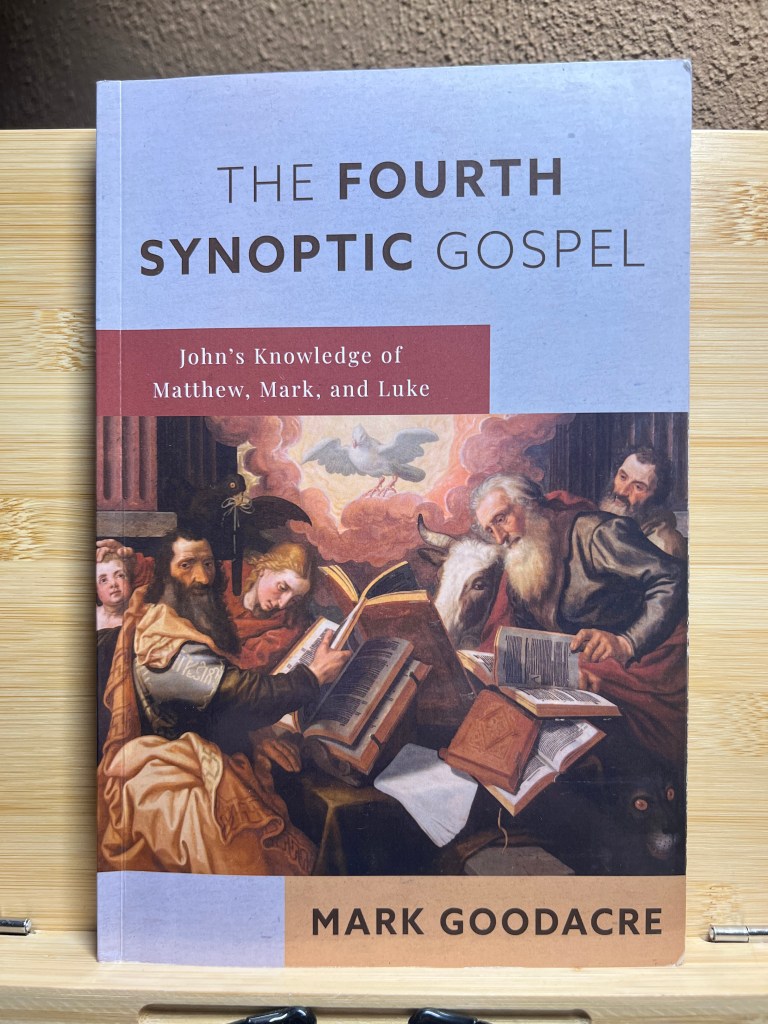
Mark Goodacre. The Fourth Synoptic Gospel: John’s Knowledge of Matthew, Mark, and Luke. Wm. B. Eerdmans Publishing Co., 2025. Paperback. $29.99. Pp. 205. ISBN 9780802875136.
That Matt. and Luke knew and made use of the Gospel of Mark is pretty much the consensus among New Testament scholars.1 But what about the Gospel of John? Did its author also utilize Mark? Did it make use of Matt. and Luke as well? The relationship of the Gospel of John to the Synoptics is the subject of Mark Goodacre’s recent book The Fourth Synoptic Gospel: John’s Knowledge of Matthew, Mark, and Luke (Wm. B. Eerdmans Publishing Co., 2025). It is one of a number of volumes published in the last decade or so that aim to demonstrate that the Gospel of John, despite frequent claims of its independence,2 nevertheless traffics in the material of its Synoptic colleagues.3
Following a brief preface that lays out the volume’s background and purpose, Goodacre begins in ch. 1 by noting that for a long time John’s knowledge of the Synoptics was the default view, a situation changed by the advent of the two-source theory of Gospel origins as well as the quests for the historical Jesus. The Gospel of John was viewed as independent of the Synoptics, a position held by the influential C.H. Dodd whose notion of “realized eschatology” helped shape NT studies for generations to come, the “lynchpin” of which “was the witness provided by John’s Gospel,” as Goodacre notes (p. 3). Prior to Dodd, Percival Gardner-Smith suggested that parallels between John and the Synoptics were the result of access to a similar oral tradition, an explanatory force that our author finds deeply problematic not only because it can explain everything but because it dismisses potential literary links entirely. Goodacre notes a number of texts that contain strings of verbatim agreements: Mark 2:9-12 and John 5:8-9; Mark 6:50 and John 6:20; Matt. 26:21, Mark 14:18, and John 13:21; and more. Though some may downplay such links, our author, drawing on the work of Charles Goodwin, looks at the ways in which the Johannine author not only treats scripture but even his own material, reasoning that if John can play fast-and-loose with them he can certainly do so with Synoptic material. Yet the “argument from omission” (p. 17) is tempting, a tool by which the differences between John and the Synoptics can be so magnified that any sense of dependence can be ruled out, though as Goodacre shows, the utility of this tool is not so great given John’s admission in John 21:25 that he left a lot out as well as the ways in which, say, Luke leaves out material from his sources, e.g., Mark. Admittedly, our author might take this amateur exegete to task for the word “dependence” (he would prefer the language of “use” or “knowledge”), and in the chapter’s closing paragraphs he notes that John’s use of the Synoptics is not merely to be found in verbatim agreement but in “macrolevel conceptual parallels” (p. 17).
Goodacre begins in ch. 2 by describing the “Johannine firewall,” that seemingly impenetrable barrier comprised of all the things that make John’s Gospel different than Matthew, Mark, and Luke and, therefore, indicate its independence of them. But our author shows that the truth is a bit more complicated as he places text after text in parallel with the Synoptic Gospels and notes similarities in language and structure as well as an example of the phenomenon of editorial fatigue which betrays John’s knowledge of the Gospel of Mark. In addition to this, the Fourth Gospel exhibits parallel orders – sequences of pericopes similar to that which we find in the Synoptics – that “suggest a literary link rather than a link deriving from oral tradition” (p. 33). Furthermore, John’s story begins similarly to that of Mark’s, with John the Baptist, and concludes by devoting (at least percentage wise) the same amount of space to Jesus’s final days in Jerusalem as Mark does as well. Goodacre also contends that “John shares with the Synoptics the same literary conceit, that the story is one in which Jesus’s identity is hidden, only to be retrospectively understood in the light of the resurrection” (p. 39). So, for example, John has insiders and outsiders just as Mark does, though with, our author contends, improvements. The Johannine Jesus also hides himself, stealing away to avoid crowds and choosing to reveal himself only to a select group, just as Mark’s Jesus does. Finally, for John the resurrection is the key to understanding Jesus’s true identity, just as it was for Mark and, in adapting and expanding that Gospel, Luke. This groundwork, our author believes, points to Johannine knowledge and use of its Synoptic counterparts.
In ch. 3, our author argues that “John’s knowledge of Mark may often have been mediated through Matthew and Luke” (p. 45). Example after example are paraded, first concerning John’s knowledge of Matthew’s Gospel but also Luke’s (and sometimes in the same parallel, like in John 19:41 which includes details found in both Matt. and Luke though not in both Matt. and Luke). These “diagnostic shards” (p. 72) point to something, and Goodacre thinks that it is to a knowledge of John’s Synoptic predecessors. Appeals to oral tradition just won’t do.
John’s presupposition of Synoptic material is the subject of ch. 4, beginning with the Evangelist’s own admission of selectivity (e.g., John 20:30). Selectivity was already a feature of the Synoptics, as indicated by texts like Mark 4:2 and 14:49. Goodacre shows how the Fourth Gospel is similar with its use of “after these things” (John 3:22; 5:1, 14; 6:1, etc.), indicating that the author did not feel compelled to narrate everything Jesus did. But many of the things that he did choose to convey to his audience count on his audience’s knowledge of his Synoptic predecessors, like when the Evangelist says in John 3:24 that “John [the Baptist] had not yet been thrown into prison,” language that, to Goodacre, “looks like an explanatory note for readers of the Synoptics to make clear where the new narrative fits in” (p. 77). In example after example, our author shows that anywhere from little phrases to poignant questions depend on Synoptic narrative being in the background, accessed by the Johannine author. And to the objection that perhaps John is relying on an oral tradition or some other hypothetical source rather than the Synoptics themselves, Goodacre contends that this move “offer[s] no help with explaining literary issues like these” (p. 89), that is, the examples he musters in support of his thesis. John, our author contends, writes not to supplant his Gospel predecessors but to expand upon them and even correct them; he needs his readers to know his Evangelical forbearers if his own account of Jesus’s life is to make any sense.
Ch. 5 turns to John’s “dramatic transformation” of Synoptic material. First, Goodacre points to places where narrative material in, say, Mark has been turned into direct speech in John, as when Mark describes the descent of the holy pneuma in Mark 1:10 which in John has been turned into John the Baptist declaring it instead in John 1:32. John is not unprecedented in this, for Matthew’s Gospel does this as well. Later authors do so similarly, as examples from the Protevangelium of James show. Our author also notes how the Johannine Evangelist takes anonymous characters from Synoptic stories and concretizes them, as when he takes the otherwise unknown person who anoints Jesus in Mark 14:3-9 and reveals her to his audience as none other than Martha’s and Lazarus’s sister Mary (John 12:1-8). There is also “intertextual dramatic irony,” that is, irony that depends on the audience’s knowledge of Synoptic material, as when the crowds query whether Jesus is the messiah, implying that he can’t be as he is from Galilee and the messiah was to come from Bethlehem (John 7:41-42), something Matt. and Luke actually claim for Jesus’s pedigree. Goodacre also shows that John’s dramatic transformation of his Synoptic sources is made manifest by dramatic revisions, as when John’s Jesus, in stark contrast to Mark’s, declares to the Father that he would not pray for salvation from the hour of his Passion (John 12:27-30; cf. Mark 14:32-42). Additionally, John’s narrative voice is strongly felt, an “obtrusive narrator” who is “actually one of [the Gospel’s] major characters” (p. 106) – the beloved disciple.
In ch. 6, Goodacre turns to the identity of the Beloved Disciple, the authority that stands behind the Fourth Gospel, in light of the Synoptics. He begins by noting that the Beloved Disciple seems to have been considered one of the twelve, with Jesus from the beginning of his ministry. Reading the Synoptic Gospels, one notices that John the son of Zebedee is frequently mentioned and appears to have been one of Jesus’s closest disciples (along side Peter and James the son of Zebedee), thus making John “the obvious contender to be the Beloved Disciple of the Fourth Gospel” (p. 112). Our author, though, is forced to contend with objections to such an identification, including the idea, rooted in John 18:15-16, that this disciple was not from Galilee but Jerusalem. Goodacre shows that this is a red herring and that the Beloved Disciple does enjoy “Galilean credentials” (p. 115). He also looks at the beginning and the end of John’s Gospel and, based upon various clues in those sections, infers that John the son of Zebedee is the best candidate for the Beloved Disciple. And to the objection that it could not have been John who wrote the Gospel that bears his name, Goodacre rightly notes that the claim to an apostolic origin is not the same thing as being of apostolic origin.
Chapter 7 is a dive into the waters of Johannine Christology, a vast lake that seemingly looks nothing like anything we find in the Synoptics but which, Goodacre contends, is nevertheless fed by Synoptic tributaries. He begins with the end, John 20:30-31, noting how “John is so often at its closest to the Synoptics when it comes to questions of Jesus’s identity” (p. 136), here specifically that he is the messianic son of God. In noting how John makes use of all but a couple of titles for Jesus in the Synoptics, he laments those scholars who “play down the extent of John’s continuity with the Synoptic Christology and rarely pause to note the possibility that John’s basic christological vocabulary is derived from the Synoptics” (p.140). John’s “I am” sayings are similarly latent in Matt., Mark, and Luke, paralleled in various ways, and our author spends time in all seven of them. He also responds to the notion that the imagery behind the sayings may be derived from an oral tradition or the Jewish scriptures instead of the Synoptics, pointing out that Johannine independence would surely have produced “I am” sayings that did not have commonalities with those other Gospels. “I am” itself is not some Johannine innovation either, as the phrase appears in Mark 6:50 // Matt 14:27 and Mark 14:62. The language of “Father” and “Son,” so prevalent in John, is also found in Matt and Luke. The so-called Johannine “thunderbolt” found in Matt 11:25-27 // Luke 10:21-22, our author contends, is “the Synoptic platform from which John launched his christological rocket” (p. 159). The Jesus of John and the Jesus of Matt., Mark, and Luke have much more in common than some would believe. And, as our author writes in the volume’s conclusion, reading John alongside the Synoptic Gospels gives us a chance to “fully appreciate it as the Fourth Gospel” (p. 163).
If I’m being honest, I came into this book already thinking that John knew and used Matt, Mark, and Luke. Wendy North’s What John Knew and What John Wrote pushed me over the edge in that regard. What Goodacre brings to the table is both a methodical appraisal of the evidence and some new light on detecting Synoptic fingerprints in the Fourth Gospel. This is on full display in ch. 5, “John’s Dramatic Transformation of the Synoptics,” a section of the volume I found utterly convincing. What the Markan Gospel offers as narration, the Johannine Evangelist turns into character speech. For example, in Mark 1:10 we read, “And just as he was coming up out of the water, he saw the heavens torn apart and the Spirit descending like a dove upon him” (NRSVue). But in John’s version, it is John the Baptist who notes this turn of events: “And John testified, ‘I saw the Spirit descending from heaven like a dove, and it remained on him” (John 1:32, NRSVue). John also does this in John 1:22-23 with the Markan prologue in Mark 1:2-3 as well as in John 18:39 with Pilate’s custom of releasing a prisoner during Passover in Mark 15:6-8. And those are just a few examples; there are more. For me, reading John as a reader of the Synoptics brings these texts alive, offering a glimpse into his modus operandi as an author. Sure, there is plenty of material in the Gospel of John that is unique, but there is also plenty of material that makes better sense as being derived from and inspired by sources we have in front of us in the New Testament. And I think Goodacre makes that case well.
- So Pheme Perkins, Introduction to the Synoptic Gospels (Wm. B. Eerdmans Publishing Co., 2007), x: “With the majority of scholars, we find that the proposal that Matthew and Luke have rewritten and supplemented Mark to be a firmly established result of scholarly investigation.” See also Bart D. Ehrman, The New Testament: A Historical Introduction to the Early Christian Writings, sixth edition (Oxford University Press, 2016), 121; Joel Marcus, Mark 1-8: A New Translation with Introduction and Commentary, AYB 27 (Yale University Press, 2000), 40. ↩︎
- On John’s independence of the Synoptics, see, e.g., Raymond E. Brown, The Gospel according to John (i-xii), AYB (Doubleday & Co., 1966), xxxiv; Craig S. Keener, The Gospel of John: A Commentary (Baker Academic, 2003), 40-42; Ehrman, The New Testament, 177-179. ↩︎
- See, e.g., James W. Barker, John’s Use of Matthew (Wipf & Stock, 2015); James W. Barker, Writing and Rewriting the Gospels: John and the Synoptics (Wm. B. Eerdmans Publishing Co., 2025); John’s Transformation of Mark, edited by Eve-Marie Becker, Helen K. Bond, and Catrin H. Williams (T&T Clark, 2021); Wendy E.S. North, What John Knew and What John Wrote: A Study in John and the Synoptics (Lexington Books/Fortress Academic, 2020). ↩︎


Just looked at this review, and though I have a basic understanding of Goodacre’s thoughts on the relationship among the Gospels, I’ve yet to read any of his books. But having read more on literary approaches to studying the New Testament (and the agency of the Gospel authors), his books might be the next logical selection for further reading.
LikeLiked by 1 person