Introduction
Okay… this post is discussing something a little bit older, but I think still pertinent. The evangelical reviews that were released of Dr. Candida Moss’ The Myth of Persecution (2013). I have continued to stumble across these, and apologists love to cite these reviews to basically claim that Dr. Moss’ work is not well received by academics and as a one-stop shop citation to discount anything that Dr. Moss has to say on the topic of Christian martyrdom. When I was initially thinking about this post, I actually contacted Dr. Moss to ask if she had issued any replies herself. She has not and gave me the go ahead for this. So, today I am going to be ripping these reviews a new one.
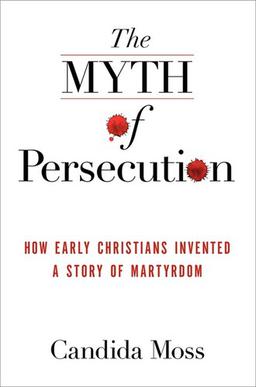
Book reviews are important. For the general public they are highly informative, giving potential readers an idea of what to expect and whether it would fit their general interests or not, as well as also giving authors good technical and audience response feedback, which is integral for improving their craft. For academics, they also signal how scholars may begin to interact with and receive a specific work, i.e., it can often set that work up for success or failure. A lack of reviews can also do this in academia (often times works that never get reviewed also get overshadowed due to a lack of publicity).
Now, when it comes to fiction reviews and the likes, authors responding to reviews of their own work is a dicey process and honestly, just don’t do that.[1] Fiction reviews are for reader communities, not for author communities. There is a boundary and space division there that authors should not be crossing over to ingratiate themselves within. Too often we see authors become virulent and abusive toward reviewers because their work was not well received.
Scholarly reviews, in my opinion, are a different matter. Here the difference is peers interacting within their own environment, and often times reviews can subtly (or not so subtly) mislead or misconstrue, which leads to a work being wrongly shelved or to a reviewer unfairly dissuading other academics from interacting with this work. This was certainly the case with the evangelical reviews of Dr. Moss’ book. These reviews were not fair evaluations or even remotely accurate portrayals but were caricatures of the lowest order.
It is further notable that all of these caricature “reviews” (to call them that is an insult to the review form) from N. Clayton Croy, Michael F. Bird, Paul L. Maier, and Ephraim Radner are all men… white passing cis men… and all are evangelical Christians. If you look at the trend of who really does not like Candida Moss’ work, there is a very specific and consistently overlapping demographic there. Men in particular seem to have some real trouble with reading and representing Moss’ work correctly. Wonder why that is… probably has nothing to do with the poor way that men in the field have historically treated their women colleagues at all or how there have been systemic disadvantages put in place to women’s work[2]…
It definitely does, and with Croy and Radner in particular, the misogyny is clear as day. So, in this post I want to address these inexcusably bad reviews and just what they represent in the field. They are absolute trash, and honestly, the fact that anyone thought these were responsible to publish says just how much men in this field are fine with mistreating their women colleagues, and how much leeway they are given to do so.
N. Clayton Croy: Misrepresentation and Historically Unnuanced
N. Clayton Croy comes off a long line of evangelical academics (and reviewers in general) who have clutched their pearls and thrown on some rose-tinted sunglasses while reading Candida Moss’ book and, as a result, caricature it to no end. Croy’s “review” is so embarrassing that its mere publication in the Review of Biblical Literature (viewable here) speaks to the lack of quality control at RBL. For a site that harps about requiring its reviewers to have at least a Master’s in a related field, and preferably be like a doctoral student or have their doctorate already, and all that jazz, Croy’s is one of a host of reviews in RBL that makes people like me question why RBL even exists anymore.
To look at a few examples, let’s start with polemical edge that Croy frames his review around. There are a lot of throwaway insults and phrases that one can use to try and degrade and devalue a work of scholarship. One of the more notable has always been to refer to something as “revisionist” history, which is what Croy does on page 6 of his review. When we think of “revisionism” it is very easy to see what Croy wants us to envision: conspiracy theories, Holocaust Denial, and similar. The reality is that all historical research is necessarily revisionist in nature. All historical research revises and alters the conceptions of past scholarship. If you have a problem with this, then your problem is with the intrinsic nature of the field. Of course, evangelicals usually do have these problems with historical research. Why? Because they don’t like traditional Christian history being found lacking and unreliable. People like Croy who really really really want Jesus to be born in Bethlehem.[3]
At one point, Croy makes the following claim:
More troubling in this chapter is the treatment of Roman sources: Tacitus and Pliny. Tacitus (Annals 15.44) records the famous incident of the Great Fire in Rome and Nero’s attempt to pin the blame on Christians. Because Tacitus wrote about fifty years after the events, and because Moss finds his use of “Christians” to be anachronistic, she asserts that Tacitus “does not provide evidence for their persecution” (139). There is simply no warrant for this kind of skepticism. The Great Fire, including Nero’s persecution of Christians, is accepted by virtually all Roman historians. The persecution is partly corroborated by Suetonius (16.2) as well as 1 Clem. 5–6. The difficulty that Nero poses for Moss’s “myth” is an early, large scale, lethal assault on Christians. Even if this was limited to Rome—which appears to be the case—it set a precedent to which later emperors and governors could appeal.[4]
Okay… well actually all of this has endless issues. Croy really wants Tacitus to just be a straight forward source for the Neronian persecution, but just ignores all the problems with it, particularly the very issues that Candida Moss herself raises. The principal issue is that the term Christian was anachronistic.[5] And Candida Moss is not alone in this even remotely. Van der Lans and Bremmer recently demonstrated that the term Christian likely did not actually come into being until probably the late first or second century CE as well.[6] Brent Shaw and also a host of Soviet academics also came to this conclusion ages ago (how dare I cite Soviets though; I’m sure Croy and Radner will get up in arms about that).[7]
And then Croy is also just misleading here. Suetonius does not even remotely describe anything that Tacitus does. Tacitus claims that Christians were executed en masse by being turned into literal human torches, because they were associated with the Great Fire of Rome’s origin. Okay… what does Suetonius say? Absolutely nothing. He says that he inflicted “punishments” on a class of Christians, and he contextualizes this among general administrative actions, the worst of which are exile. At no point do we get the idea that Suetonius had any mass persecution of violence against Christians in mind.
And what of 1 Clement? Well Croy is again playing fast and loose with reality. 1 Clement actually does not have any explicit reference to any Neronian persecution. As Moss noted in her book (which Croy just again conveniently overlooks), the author of 1 Clement has internal Christian jealousy in mind as the cause of the deaths of the apostles.[8] In fact, just reading 1 Clement and removing the projection of later Christian mythos from the equation, one finds a very peculiar reference in 1 Clement 6.3 to the murder of Abel, which Clement is using to contextualize the “persecutions” that Christians are facing. Who was Abel killed by again? Oh yeah, his own brother. Clement is saying that Christians are being violent to each other… in fact, the implication in my view seems to be that Christians killed their own apostles. Another indication of this is the accusation that they persecuted the prophets, which was a trope in Second Temple and early Christian literature, i.e., that the prophets were killed by their own people (an accusation that Clement is now levying at Christians with the apostles).[9] The “great multitude” that is referenced in 6.1 is not clearly referring to any singular event. When Clement says that there “may be added a great multitude” of those who bore witness and were persecuted, we can easily take this to mean a great multitude of people of various differing events.
What about Pliny? Well Croy writes this:
Pliny is harder for Moss to dismiss, since he deals with contemporary issues in his own administration. Trajan’s response is notoriously terse and does not directly address every issue that Pliny raised, but the ambiguity does not permit Moss’s conclusion that “the climate was hostile, but there was no active persecution” (145). Both Pliny’s letter and Trajan’s response presuppose that being a Christian was punishable by death. The correspondence does not create a policy but rather clarifies a preexisting practice. Whether it had the force of imperial law would have mattered little to the Christians whom Pliny executed.
This is just a load of rubbish and anyone who has actually read Pliny’s correspondence with Trajan knows this. Merely being a Christian is not the reason for these people being executed, it is because they are being socially disruptive. In fact, this is just all part of general legislation. As Moss writes, “Pliny makes inquiries about the enforcement of regulations, implementation of the imperial ban on clubs and associations, interpretation of religious customs, treatment of slaves, and use of Roman troops in the region” (140). Contrary to Croy’s unevidenced claim that these “presuppose that being a Christian was punishable by death,” Pliny makes it clear he has no idea what to presuppose because, as Moss again notes, “Pliny is saying that he has never participated in the trials of Christians prior to this point, and he is unsure about how best to proceed” (140). In fact, Pliny just outright states he is unsure whether inherently being a Christian, i.e., the name justifies death. He says, and I quote:
Having never been present at any trials of the Christians, I am unacquainted with the method and limits to be observed either in examining or punishing them. Whether any difference is to be made on account of age, or no distinction allowed between the youngest and the adult; whether repentance admits to a pardon, or if a man has been once a Christian it avails him nothing to recant; whether the mere profession of Christianity, albeit without crimes, or only the crimes associated therewith are punishable in all these points I am greatly doubtful. (here)
And Trajan’s response is… don’t go persecuting Christians, don’t seek them out, and don’t bother with them unless you have a confirmed case brought before you by non-anonymous accusers. Trajan actively dissuades any crusade or persecutory action against Christians. The entire reason that Christians are being punished is because (A) the law banning unlawful associations which applied to every group (so not a specific Christian persecution), and (B) their failure to pay dues at the temples and sacred festivals (which was again expected of all Romans, this is not specifically a persecution of Christians). As Moss remarks, “The cause of Pliny’s sudden interest appears to be economic” and Christianity had been spreading “with the result that temples had been already deserted and no one was purchasing animals for sacrifice” (140–41). So when Croy also remarks, “Even when martyrdom was not being carried out, all that stood between Christians and the executioner was the lack of a delator (an accuser)” he is again, not being accurate. A mere accuser is not actually enough for Pliny or Trajan, especially not anonymous ones. Given that they had no active goal in seeking out Christians and anonymous accusations were not allowed, this actually greatly reduced the chances of any Christian being executed. And again, these executions were not because Christianity was targeted… it was because they were like every other association that was not governmentally approved and treated as such. As Moss notes, “Reading between the lines of the correspondence, it seems that Pliny really just wants the Christians to go away. Once they are in his courtroom, Pliny has no option but to deal with the Christians, but he has no desire to seek them out” (143). How is this difficult for Moss? It isn’t. Croy just once again is pontificating without actually engaging with Moss’ actual work, and further has this misconstrued idea of what is actually in Pliny’s letters.
But here Croy also gets worse and starts also implicitly caricaturing Moss’ work. For instance, on page 6 he writes:
In chapter 7 Moss identifies Eusebius as the architect of the myth [of persecution]. Through a selective and censorial telling of the story of the Christianity, Eusebius created the myth of the persecuted church. According to Moss, his use of the martyrs amounts to a power play; he associates martyrs with the orthodox bishops of his own day and their persecutors with the heretics. But Eusebius lived through the “Great Persecution” under Diocletian. Even if he sometimes employs the rhetorical power of martyrs for the sake of the church, it is hardly the case that the persecution that he himself witnessed or knew of is only a grand, fraudulent myth.
This is just flat out misrepresenting what Moss writes, because Moss does not actually deny that the persecution under Diocletian happened as Croy is suggesting here. He is misrepresenting Moss’ work in an effort to make it look worse, and so he can follow it up with this banger of a quip:
There is irony in Moss’s criticism of Eusebius’s method: “he suppresses the voices of those who disagree with him and ignores information that does not fit with his argument” (217). One could change the pronouns in that sentence to the feminine and it would describe Moss to a tee.
Well that is how gendered pronouns work in the English language, I am glad you noticed that. Now if only you could apply your language erudition to actually reading Candida Moss’ book. So, what does Candida Moss actually say on Diocletian’s persecution?
Up until this point we have seen Christians caught up in general legislation designed for everyone, the expulsion of Christians from position of power, the execution of powerful Christians, and sets of procedures designed to deal with Christians in the courtroom. But with the accession of the emperor Diocletian, we find something quite different. His legislation inaugurates the first and only period of persecution that fits with popularly held notions about persecution in the early church.[10]
So Croy is just outright misrepresenting Dr. Moss here. In the actual book, Dr. Moss is very explicit that this persecution happened, that it was a sustained persecution, which “came in waves” (155). Now, there are some caveats to this. As Moss remarks, “there was more room for maneuvering than we might think” (155). Moss is not arguing that no persecution happened at all, but that it was clearly exaggerated (and that is no surprise) and that we have clear evidence that the edicts under Diocletian were not uniformly enforced. In fact, some regions touted a “blood-free track record” in dealing with their Christian populace.[11] But some regions like the governors of Palestine, were “enthusiastic persecutors” of Christians.[12] So no, Moss is not saying that the persecution under Diocletian was “a grand, fraudulent myth.” At my most charitable, I can only conclude that Croy did not carefully (or at all) read this chapter of Dr. Moss’ book and just went with what he guessed she would have said. My less charitable interpretation is that he is just being actively disingenuous.
At this point, Croy’s hand becomes fully revealed. He shows his very specific conservative take on Christian persecution when he then remarks, on chapter 8:
The Left’s favorite whipping boys—Glenn Beck, Newt Gingrich, Rush Limbaugh, Ann Coulter, and pro-life bishops—are trotted out. When they express concerns about life and religious liberty, Moss finds the perpetuation of the “myth” of Christian martyrdom. Moss reasserts: “Very few Christians died, and when they did die, it was often because they were seen as politically subversive” (255). Doesn’t this sound just a bit like (first minimizing and then) blaming the victims?
No Croy, Dr. Moss has not blamed the victims of anything nor minimizing what actual victims have experienced. Being “seen as politically subversive” does not make it your fault for being seen that way. In fact, Croy is playing into the myth of persecution by attempting to construe critics as victim blaming. Rightwingers typically do this quite often to avoid scrutiny and criticism; it is a coopting of the language of victims and their lived experiences, which they do in an attempt to undermine the systematic critiques of their opponents. We can also see how Croy just reveals his cards here, as he makes it clear that he sympathizes with these hacks and frauds. The “concerns about life” (i.e., Croy is a misogynist and thinks it is fine to challenge abortion rights) and “religious liberty” (i.e., discrimination against people using religion as an excuse) are just code words meant to hide what is really happening… which is part of the myth building exercise. You reduce the harm that your own side is doing, so that it actually makes you sound like a victim when people retort. As a result, his claim of “blaming the victims” becomes more forceful by reframing Christian bigotry as “religious liberty” and “concerns about life.” It is a disingenuous tactic, but Croy’s political rightwing hand is revealed even more when he offers a counter volume to Moss’:
One might judge that conservative Christians in the West have sometimes overplayed the persecution card, but they have not created instances of cultural hostility out of whole cloth, and they certainly did not create the “Age of the Martyrs” out of thin air. More important, Moss largely overlooks modern Christianity in the two-thirds world, especially in the Middle East and in Communist states. Here we find not just cultural insensitivity but old-fashioned persecution: arrests, beatings, and decapitations. Exactly one week after the publication of Moss’s book, another book came out: Persecuted: The Global Assault on Christians, authored by Paul Marshall, Lela Gilbert, and Nina Shea. They document persecution in about forty different countries.
And here we are just met with more meandering. Firstly, the volume he mentions by Marshall, Gilbert, and Shea, Persecuted: The Global Assault on Christians (2013) is not even remotely a rigorous or reliable attempt to document Christian persecution. It is a shill political propaganda piece written for a conservative thinktank called the Hudson Institute’s Center for Religious Freedom. Don’t let the name fool you. This is “religious freedom” in the way that Trumper Republicans wanting businesses to discriminate against Trans people use “religious freedom.” They write endless blog posts about various nothing burger situations where “persecution” comes down to someone just being called out for being a bigoted jerk, or similar. But this is what these bogus thinktanks filled with disingenuous pundits do: present a bunch of nothing and twist it into “we are persecuted!” as a way to continue presenting Christians as this marginalized group, and therefore distract from the fact that Christians in our society today are actively disenfranchising various groups under the guise of “religious freedom” and similar. These are works meant to enable bigotry. This institute promotes antiabortion, anti-Obamacare, Islamaphobia, transphobia, etc. But more to the point, Croy seems to have this idea (or wants us to think) that Dr. Moss is claiming that Christian persecution is all a myth and does not happen. Which is just nonsense. She actively notes where it does happen in history and uses various examples of it.
What Dr. Moss is criticizing is how these examples are (re)invented into a interpretive matrix and narrative of “Christian persecution,” which Christians interpret their experiences and self-identities through. Moss writes:
In this understanding of what it means to be a Christian, a lot of weight rests on the history of the early church. Bishop Jenky’s speech cites only Jesus and the early Christians before moving to the modern period. If there was no persecuted early church, he could not claim that Christians should expect persecution. Even though Jesus predicted the suffering of his followers, it is the belief that Jesus’s statements were proven in the persecution of the early church that gives force to the idea that Christians are always persecuted. It is this idea, the idea that Christians are always persecuted, that authenticates modern Christian appropriations of martyrdom. It provides the interpretive lens through which to view all kinds of Christian experiences in the world as a struggle between “us” and “them.” Without this history and interpretive lens, each situation would have to be judged on its own merits (13).
When Christians have been persecuted or are the victims of other political or legal quandaries, these are not all the result of any similar anti-Christian mindset. The case with Pliny showcases this. He and Trajan are not actively looking for Christians, nor are they automatically killing Christians for merely being Christian. Christians are punished because they fail to perform their socially mandated and obligated deeds (i.e., paying their dues to the emperor and imperial cult). This is not a targeted persecution of Christians but is part of a general criminalization of non-approved cults that do not exhibit their proper social obligations. This is completely different from what Diocletian does. And, even if the Neronian persecution were historical, would be more different still. Neither of these three are actually a result of the same mindset, legal procedure, or with the same goals. Nero was looking for an out, a scapegoat, for a specific and particular situation. Christians happened to provide one, hence a localized persecution of Rome according to Tacitus. He was not attempting any sustained persecution of Christians. Diocletian’s was a legalized series of edicts to target and oppress Christians as a whole. Trajan and Pliny just didn’t want a random illegal cult wandering around not paying their dues. These are three very different kinds of events… subsuming them into a history of persecution only perpetuates a false narrative that Christians have been always persecuted. In the case of Pliny and Trajan this is not a persecution at all. This is just Christians being treated like any other non-approved association. They are not being specifically singled out, except to ask what to do with them (the answer Trajan provides is thus to treat them like they would any other unapproved group). Nero’s is not a systemic attempt at destroying Christianity or even remotely similar. It is just an attempt to get people to stop giving him a side-eye.
But all of these continue to be swept up in this grand narrative of Christian persecution and martyrdom. As Dr. Moss writes, “The malleability of martyrs is even more acute when they are treated en masse as part of the persecuted history of Christianity. Just as many French political organizations have selected Joan of Arc, members of any Christian group can claim to be persecuted as long as they feel opposed” (249). Moss is not saying that Christians have never been persecuted in any form, or that they never suffered violence and death at the hands of Roman imperial courts and edicts. She is saying that these events have been exaggerated often, some of them are wholly made up, and all of them are being improperly swept up in a mythological history of Christian persecution which has twisted these events to fit a narrative that Christians have always been persecuted, and which serves modern political agendas, and today especially of conservatives who use it to justify the disenfranchisement of non-Christian and Christian minorities, and excuse bigotry. No one is denying that Christians were targeted and persecuted massively under the Soviet Union, or that they have not suffered in the Middle East, or abroad. These are all red herrings from Croy meant to distract from Moss’ actual thesis, a thesis for which he has no real engagement.
Croy’s entire review is littered in these misrepresentations, disingenuous caricatures, and worse. It is belittling. Though, in terms of how evangelical scholars responded, his is actually one of the milder.
Ephraim Radner: Dishonest Misogynist Extraordinaire
This does not even qualify as a review. This is just a misogynistic hitpiece, that Radner threw on paper while vociferously polishing the pearls he clutches as if they hold the key to his life. This is how Radner opens his “review” (here):
The tedium of repeated déjà vu in this sad little volume did at least send me back to Gibbon’s Decline and Fall. It is as if a publisher came to Candida Moss, a professor of New Testament and Early Christianity at Notre Dame, with a proposal for a quick buck, relying on the political twitter of the times: “You’re an expert: Reframe Gibbon’s notorious chapter on the Romans and the Christians with some contemporary scholarship and cultural fillips, and we can put out a nifty pamphlet that’ll sell.”
Radner is obsessed with the idea that Candida Moss must have just copied her entire idea from Gibbon’s Decline and Fall of the Roman Empire. And when I say obsessed, I mean he cannot help but bring it up constantly. Radner’s response is misogynistic on levels that can hardly be expressed. Candida Moss just wants a “quick buck”; that Moss is just copying Gibbon; that Moss thinks this is “all a sham”; that Moss is sympathetic to the Roman persecutors (again a veiled accusation of victim blaming); etc. And of course, all of this is framed with Radner’s own intense conservative political convictions. Radner writes:
[…] Christian worries over court-mandated curricula on reframed patterns of sexual life, the targeting of churches with charges of “hate speech” due to their moral convictions, the civil redefinitions of marriage, and the range of matters dealing with contraception and abortion are hardly stoked by ignorant pondering over fraudulent martyr stories. To argue this is to try to change the subject.
Rather, the worries derive from the well-founded fear that a hard-won civil space in which a peaceable Christian expression of and witness to social renewal, as conservatives may see it, is being deliberately eroded.
So, in Radner’s mind, Christians have a “well-founded fear” because… women have the right to choose what they do with their own body, that people have the right to marry whom they want (or divorce), and that churches are called out for their ongoing bigotry toward people.
But here we again have a misrepresentation. Candida Moss is not saying that these Christians, who are up in arms because their social status is now being challenged (which Radner dislikes clearly as well), are being “stoked by ignorant pondering over fraudulent martyr stories.” I am, at this point, thoroughly convinced that Radner has not actually read Moss’ book, or at best only skimmed it, because his consistent and disingenuous misrepresentation of all of her points is so consistent (coupled also with his lack of any noteworthy quotes from the actual book itself) that it is difficult to see how this man has any idea of what is even in it. And this is the most charitable I can possible be, because the only other option is that this man is actively dishonest. Moss is arguing that the myth of persecution is a narrative of history that has been created and manipulated to validate Christians in their belief of persecution and in furtherance of their political agendas, which has led to mass violence against their rivals. It is not some “ignorant pondering over fraudulent martyr stories” but is a matrix of thinking and conceiving themselves and their place in history. And she points to many examples of how Christians continuously do this. It is pretty difficult to understand how this man actually read Moss’ work when, instead of quoting her, he quotes a random person talking about Gibbon at one point instead:
[Speaking of Moss’ book] This wasn’t real “persecution” but understandable and helpful “police action” (as the historian J. G. A. Pocock puts it in his description of Gibbon).
Yes, this is definitely a man who has carefully read Candida Moss’ work and is not just trying to find an axe to grind, because he is bloody upset and has absolutely no valid criticisms.
When Radner says things like, “But she offers no evidence that the ‘Sunday school’ fantasies about Christians being thrown to the lions inform the Church’s current resistance to things like abortion,” he is being actively disingenuous. Moss never said the “thrown to the lions” is what specifically informs their complex about abortion. But she does show how other narratives are used this way. In fact, Candida Moss provides an actual example of how a martyr story of Gianna Molla was used to justify antiabortion thought among Catholics in 2009 (252). Christians do look back to this history of “persecution” and “martyrdom” as a way to validate their own perceptions of persecution and their own modern political positions and agendas. So when Radner says that Moss “offers no evidence” of this position, he is either lying about it or he never read the book (and therefore the entire review is dishonest). Radner replies that, “She [Moss] simply ignores the importance of the early Church’s consistent practical and theological rejection of abortion and of other death-dealing customs like the gladiatorial games.” But this is just a naïve and childish view of history. In Radner’s mind, apparently, Christians do not spend time in “ignorant pondering over fraudulent martyr stories.” No… they spend their time meandering over centuries old theological treatises written in Latin and Greek about abortion and gladiator battles? Narratives and modes of thinking are not mutually exclusive. Radner wants to draw a line and expunge the persecution narrative from this equation because… if he does not then it validates Moss’ thesis, and therefore his entire polemical screed is seen for what it is: drivel. He has to have it one or the other: either they are informed by the persecution myth, or they are informed by Church tradition on abortion. It couldn’t possibly be that both are true.
Meanwhile in this place we call reality Candida Moss is proven correct. Here we have “religious persecution” used to justify antiabortion positions among Catholics (here). Oh and to make it better, that piece opens by quoting Irenaeus… so yes, Christians do actually go around pontificating on ancient writings to justify their persecution narratives. And here we have Focus on the Family, which again meanders on ancient Christian writings… including Tertullian whom they say, “worked tirelessly, defending Christianity from external persecution and internal heresy” (here), again to help assemble their antiabortion narrative. And here we have another place promoting Christian persecution narratives and opening it by specifically discussing how “During the early years of Christian martyrdom, Christians fled by the thousands into underground caverns outside of Rome” and continuing “Still, persecution and martyrdom, for Christ’s sake, are not simply a thing of the past. Far from it” and of course one of the sources of this are “pro-abortion attacks on churches” (here). Like, a basic google search of two minutes automatically validates Moss’ conclusion. God forbid we look at conservative books from Rush Limbaugh or similar and find this again proven.
Candida Moss is completely correct, and Radner is just attempting to obscure the reality of the situation. Why? Because he wants to downplay, degrade, and caricature her scholarship and hide the fact that, yes, Christians use this false narrative of persecution as an excuse to defend and bolster their conservative political agendas, which actively hurt women. As a result, Radner slings insults and polemics, and promotes actively misogynistic behavior, treating her work as just “quick buck” material in an attempt to ignore it. Radner cannot have the conservative agenda scrutinized. Like with Croy and “religious liberty” and “concern about life,” Radner instead wants to reframe the abuses of women in the church, and church stances on antiabortion and anticontraception as “moral convictions” of the church, which have been unfairly deemed “hate speech.” Radner does not want Moss’ theory to be correct, because he does not want attention to be pointed at him for actively playing into this very narrative that Moss is criticizing as false and incorrect. And like Croy, of course, it now sounds justified of Radner to whinge about the poor Christians being unfairly accused of “hate speech” because they have “moral convictions.” It is a disingenuous attempt to reframe abuse and bigotry so that the abusive institutions (and those who uphold them) are seen as victims. Which, of course, means that his own misogyny becomes obscured as well.
The links with Gibbon in particular are an attempt to basically say that her work is antiquated and therefore not worth attention. He goes beyond this. He is essentially saying she is borrowing Gibbon’s idea and “reframing” it (see above quote). Of course, anyone who has actually read the sixteenth chapter of Gibbon’s Decline and Fall will immediately note… wait they aren’t really that similar at all. Gibbon and Moss do not argue the same on Tacitus or the Neronian persecution. Nor on Domitian. In fact, they also do not even have remotely the same thesis either. Gibbon’s main point is to note that there are a lot of problems with our evidence, but mostly that Christians actually were far more violent to each other than whatever they received from the “infidels.” As Gibbon concludes:
We shall conclude this chapter by a melancholy truth which obtrudes itself on the reluctant mind; that, even admitting, without hesitation or inquiry, all that history has recorded, or devotion has feigned, on the subject of martyrdoms, it must still be acknowledged that the Christians, in the course of their intestine dissensions, have inflicted far greater severities on each other than they had experienced from the zeal of infidels. (here)
So… what is Radner actually saying? That he probably doesn’t remember Gibbon very well, that he did not bother to carefully or thoughtfully read Moss’ work, and that he cannot help but misconstrue, caricature, and misrepresent everything that Moss writes. He is either malicious and incompetent (and he is malicious, as his constant aspersions and polemics attest) or malicious and dishonest. His misogyny is palpable. If Radner’s reading skills of Candida Moss’ book are anything to judge by, then we can be fairly sure his understanding of Gibbon (and really just historical research in general) is shallow, unnuanced, misogynistic, and actively apologetic in favor of Christian traditional narratives. Hence why he then bemoans the “intellectual dead ends of historical criticism.” Of course, he does not like historical criticism… it doesn’t validate his feelings and favorite stories of Christian antiquity, or his conservative political agenda. Thus, it must be an intellectual dead end.
There is really nothing of real substance to Radner’s response. It is just insults, polemics, false assertions, misrepresentations, caricatures, and worse. Radner has no critical eye, no worthwhile things to say about the volume, he cannot even competently represent what was in it. Instead, he is reduced to belittling Candida Moss with a misogynistic fervor that would make Andrew Tate proud, because he is either incapable of honestly engaging with her thesis or is unwilling to do so. Instead, he actually just ends up affirming everything that she wrote. He is actively participating in this myth of persecution, and he also displays how shallow and fragile that myth actually is. It relies on polemics, bigotry, and a distaste for historical research to even survive.
Conclusions
Croy and Radner replied with two reviews which are honestly of such middling low quality, and of such pathetically poor engagement with their source material, that I legitimately think they qualify for retraction. Croy misconstrues what Moss writes, does not actually engage with the content of her work (the most he accomplishes are cherry-picked quotes that ignore the lengthier arguments and details of her work), issues a series of polemics, and largely just relies on the same conservative political agendas that Moss is calling out. His “review” is a veiled rightwing political screed and has no substantive content to offer. The misconstruing of Moss’ work alone demonstrates someone who either did not read the work carefully, or is not willing to honestly engage with it, and either way, that review is a stain on RBL and the fact it was published is embarrassing.
Radner’s is just outright disgusting. I know of no other way to describe this work other than actively malicious (which I believe is evidenced from his insults, caricatures, and overall misogynistic and hostile behavior), and disingenuous in every way. He does not engage substantially with any of Dr. Moss’ work, he misrepresents her thesis, he belittles her book as just being derived from Gibbon, he promotes his conservative political agendas and shows active disdain for “historical criticism”, he claims that Moss is just doing this for a quick buck, and performs all of the same obscuring tactics to hide the fact that he, like Croy, identifies with an evangelical Christian bigoted focal group that desperately wants to see itself as persecuted in order to justify said bigotry. All I can say is after reading this, I have no respect for Radner as a scholar or a person. Everything about his “review” only revealed a repugnantly arrogant and misogynistic individual.
These are not “reviews” in any meaningful sense. They are hit pieces meant to reinforce the bigoted and sexist positions of conservative authority and degrade the voice of a woman who has rightfully and eruditely written a monumental volume deconstructing these false narratives. The best that these two could offer were disingenuous caricatures, political aversions to her thought, and veiled accusations of “victim blaming” meant to virtue signal Dr. Candida Moss’ work into obscurity. And frankly, I continue to see these misrepresentations of her work… from men. It is always men. Just recently Dr. Moss wrote a Twitter thread (here) on being misrepresented again, and how these have often led to death and rape threats against her… and I’m just going to guess these are, again, from self-identifying Christian men. Dr. Moss has been continuously targeted by misogyny both within and outside of academia for her public facing work dismantling fabricated Christian narratives, and these two petulant caricature “reviews” from supposed academics just add to this. What Croy and Radner did is, at best, sexist and disingenuous and at worst knowingly dishonest and malicious drivel. Nothing they say with regard to The Myth of Persecution is even remotely credible, and it speaks to their own lack of standards that they think this is remotely acceptable to publish. The publication of Croy’s screed further speaks to the lack of quality control at RBL and their allowance for this kind of misogynistic and debasing material.
These two “reviews” speak to the gendered differences in this field, and how abusive and disingenuous behavior by men is allowed without question, while women are punished for their radical or innovative ideas in the field. Croy and Radner are shameful representations of the engrained sexism in this field.
[1] If you want a video as to why, see Reads with Rachel’s video (here).
[2] See Sara Parks’ excellent essay, here. I will sing never-ending praise of Park’s essay “The Brooten Phenomenon” go read it.
[3] N. Clayton Croy, Escaping Shame: Mary’s Dilemma and the Birthplace of Jesus (Leiden: Brill, 2022).
[4] Page 4 of the RBL review.
[5] Candida Moss, The Myth of Persecution: How Early Christians Invented a Story of Martyrdom (New York: HarperOne, 2013), 139.
[6] Birgit Van der Lans and Jan N. Bremmer, “Tacitus and the Persecution of the Christians: An Invention of Tradition?” Eirene: Studia Graeca et Latina 53 (2017): 299–331.
[7] Brent D. Shaw, “The Myth of the Neronian Persecution,” Journal of Roman Studies 105 (2015): 73–100; S. I. Kovalev, Osnovnyye Voprosy Proiskhozhdeniya Khristianstva (Moskva: Nauka, 1964), 190–91; A. B. Ranovich, O Rannem Khristianstve (Moskva: Izdatel’stvo Akademii Nauka SSSR, 1959), 244–45; I. Lenzman, L’Origine du christianisme (Moscou: Editions en langues etrangeres, 1961), 69–71. I have also defended Moss and Shaw’s positions as well, see C. M. Hansen, “The Number of the Myth: A Defense of the Ahistoricity of the Neronian Persecution,” Journal of Early Christian History (2023), here; idem, “The Problem of Annals 15.44: On the Plinian Origin of Tacitus’ Information on Christians,” Journal of Early Christian History 13, no. 1 (2023): 62–80.
[8] Moss, The Myth of Persecution, 136–37.
[9] See Frank D. Gilliard, “Paul and the Killing of the Prophets in 1 Thess. 2:15,” Novum Testamentum 36, no. 3 (1994): 259–70 and Jeffrey S. Lamp, “Is Paul Anti-Jewish? Testament of Levi 6 in the Interpretation of 1 Thessalonians 2:13-16,” Catholic Biblical Quarterly 65, no. 3 (2003): 408–27. Aside from 1 Thess. 2:14–16, see also Neh. 9:26; Testament of Levi 6; Matthew 5:10–12.
[10] Moss, The Myth of Persecution, 154.
[11] Moss, The Myth of Persecution, 158.
[12] Moss, The Myth of Persecution, 158.

