“When we use AI to flesh out ideas, we lose the most important part of the writing process: thinking.” – Eve Fairbanks, “The Biggest Tell That Something Was Written by AI,” The Atlantic (5.29.26).
- Dan McClellan looks at “mind-blowing Bible facts” that are not mind-blowing and not facts.
- Robyn Walsh discusses why so many Christian mss come from Egypt. (It’s for a far more mundane reason than some might suppose.)
- Are there dinosaurs in the Bible? No. Eric Eykel provides a bit more explanation and discussion.
- John Collins was interviewed by Bart Ehrman about Judaism before Jesus. (I love Collins’ accent and will sometimes read something he has written with that accent in my head. Now, if someone could record him saying “The Banshee!” a la Darby O’Gill and the Little People, I would be over the moon.)
- Peter, Cephas, and Simon. Three different people? One person? What is going on here? Over at Reconstructed Bible you can read all about it. (I’m not convinced that Simon and Peter/Cephas were two different people. But then, it isn’t clear to me that Cephas was actually named Simon. He may have been if the Gospels are right.)
- James McGrath alerted his audience that his book The A to Z of the New Testament is selling at a discounted price over at Amazon. (Hopefully by the time this Roundup goes up it’s still fairly cheap.) You can read my review of McGrath’s book to whet your appetite.
- C.J. Cornthwaite talks about the idea that the presence of women at the empty tomb is “embarrassing” and, therefore, lends credibility to the Evangelists’ accounts. He makes some really good points.
- Reading!
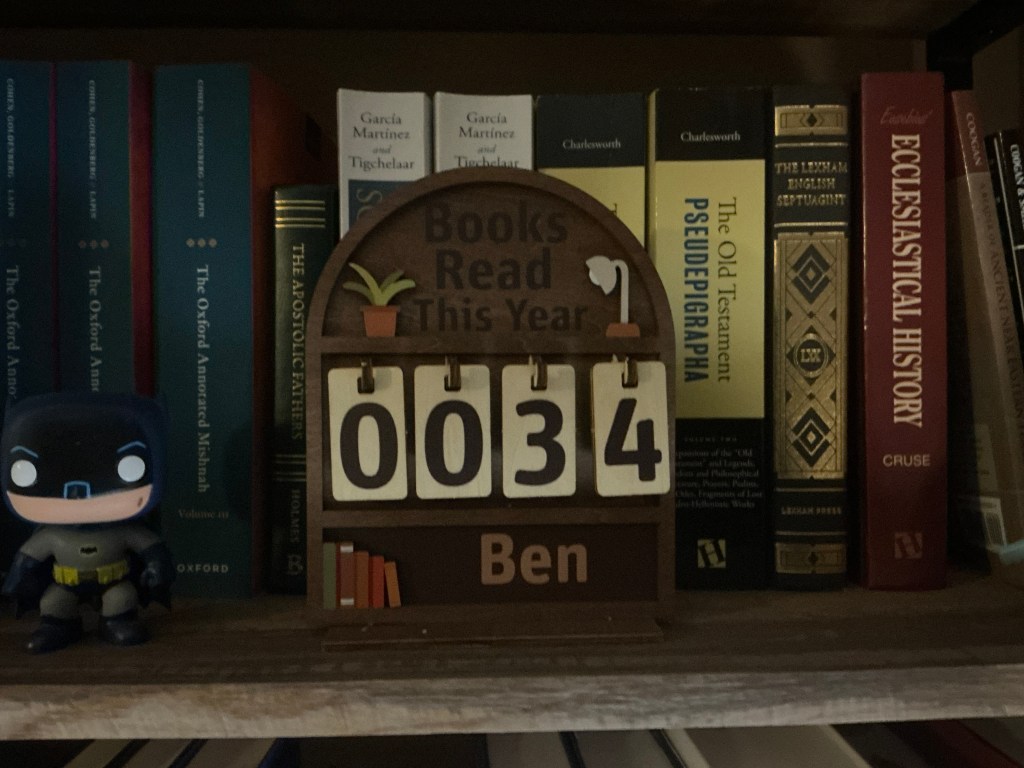


And much like Raymond E. Brown and Mark S. Smith, Collins seems to be one of those accomplished, mainstream, modern Catholic scholars whose work conservative Catholic apologists infrequently, if ever, engage in any serious way. (A quick search for John J. Collins on the websites for Catholic Answers, Dave Armstrong, and SJ Thomason turned up woefully few mentions, and no sustained discussions.) Funny, that.
LikeLiked by 1 person
I think Michael Coogan is Catholic too. (One of my favorite commentaries on Mark is written by two Catholic scholars, John Donahue and Daniel Harrington.) So much good scholarship coming from Catholic scholars!
And you don’t know me! Maybe I’ll start counting the backs of shampoo bottles to get my number into the four-digits!
🙂
LikeLike
Neat selection for the round-up this week.
Glad to see more people discussing the perils of A.I., especially for the writer’s craft. It’s one thing to use it as a sort of enhanced proof-reader but another altogether to simply generate content without being the least bit transparent about its provenance.
(In fact, someone might need to come up with a sort of watermark of human composition for writers in the future. Maybe deliberating including an instance of poor grammar or a duplicate word. But, hopefully, there’s better solutions than those.)
Adding to some of the points everyone has made regarding the women at the empty tomb, I wonder if there might a connection to the whole notion about which stories/myths circulate the best: those that subvert certain expectations of listeners but not excessively. Setting aside the possible role of women in burial, altering a detail in one or two places from what someone might have otherwise come up with could have made it more memorable.
My thoughts above are probably built off of some ideas of thinkers like Pascal Boyer in his Religion Explained. He has an interesting discussion on which religious ideas spread best, which tend to be those that balance the subversion of everyday concepts with resemblance to typical notions or objects in the human mind.
-J Source
LikeLiked by 1 person
I’ll need to add Boyer to my list of things to engage.
It really does worry me that people are going to start depending more and more on AI to do things that are so uniquely human. We lose so much when we outsource to things without minds. Writing is such a human thing.
LikeLike
Agreed. There’s a famous argument (“the Chinese Room”) that attempts to demonstrate that a computer cannot be considered as engaged in cognition/thinking, regardless of its capabilities.
John Searle, the philosopher who is credited with it, has received some criticism for the way he formulated his arguments, but my suspicion is that the general idea is correct: algorithms don’t “think.”
Now if you could recreate something like the human brain and its cognitive processes using hardware (with the software being equivalent to “consciousness”), you would probably have a better claim to have built a thinking machine. But this kind of proves the above, since the creation would effectively be an android (or gynoid).
Long story short: Who wants to build a real-life Commander Data (or a replicant)?
As an aside, I think the best current use of “A.I.” would probably be for limited uses (such as rapid calculations or other similar tasks). Perhaps it could serve some sort of auxiliary role to free up humans for more creative or higher-order tasks.
LikeLiked by 1 person
Why give any credence to a piece that comes close to Joe Atwill claiming the Romans invented Jesus, re the “Simon” vs “Peter”? Because, that’s what that piece does.
LikeLike